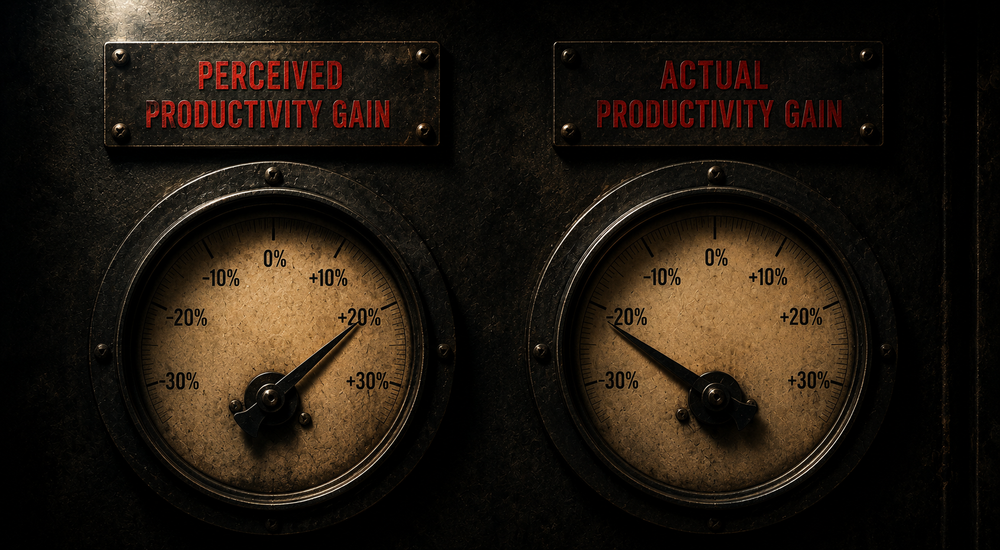
Have you noticed that some of your clients, maybe many, can't make a decision right now?
The small calls still move, but it's the ones that matter that sit. It's a sixth meeting instead of a yes...and what's underneath, whether you realize it or not, is a quiet question: should we wait, won't AI make this cheaper or pointless in six months anyway. And under that question sits a quieter bet: that the machine will eventually tell them what to do.
One of my agency clients in Australia, that spent its early years as Mentally Friendly and later became Future Friendly, was selling the answer to that paralysis almost a decade before it went mainstream.
Their whole pitch was one simple idea: Give us only your hardest problems, the ones you've tried to solve two or three times and failed. That's the work we do.
Back then, no language models in the room, no AI strategy on the agenda, no board member asking what the firm was doing about all this...just a bald proposition: We. Do. Judgment. Better.
And they had it right; today's paralyzed client is not a problem, but the core of a big opportunity. And Future Friendly built a business on walking through that door.
Assembly versus Judgment
Nick and Jon understood that an agency sells two things that arrive on one invoice looking like a single thing. There's the work of figuring out what the work actually is: reading the situation, noticing what the client hasn't said, deciding what's worth making and what isn't. And there's the work of making it: the design, the copy, the code, the campaign. The first is judgment. The second is assembly. Nick, who was also teh ECD, didn't like being in the assembly business. They made a bet to lead the sale with judgment at a moment when nearly everyone else was still selling assembly.
Since forever in the agency world the money has been in assembly – it shaped how agencies got built, staffed, and priced. The client usually held the judgment about their own business: what it needed, where it was going, what mattered this year. The agency held the assembly, plus a thin band of judgment about its own output: is this good work, did we read the brief right, is this on strategy.
The agency's judgment mostly pointed back at its own assembly, only rarely climbing up into the client's judgment and assembly. Some agencies sold that sliver and called it strategy. But the industry practice was to sell assembly with a strategy slide/deck on top.
AI Machine Arrives, Eats Assembly for Lunch.
The comfortable version of today's AI story says the production work gets automated while the thinking stays human, so the smart agency simply moves toward the thinking, the judgment.
Yes, but that skips what happens to the thinking.
When assembly collapses in value, it drags down the judgment fastened to it. Knowing how to execute something beautifully is worth a great deal less when the something is nearly free to make. So an agency built the usual way doesn't lose one layer. It loses the layer it sold, and most of the judgment that served that layer leaves with it. What stays standing is the band the agency invested in least: judgment about the client's own situation,their problems and their opportunities.
The agency-client relationship was always metered on assembly: hours, deliverables, retainers sized to volume of output. When output stops being scarce, the relationship doesn't just get cheaper. It loses its unit of measure. You were selling a thing measured in production, and production is exactly what got cheap.
Repricing around judgment sounds like the obvious fix, except judgment resists the meter. You can't bill an hour for noticing the thing nobody else noticed. (I've watched sharp founders try to write that line item; it never holds.) The economics of judgment are real, but they don't behave like the economics of assembly.
The Real Paralysis Paradox
Let's come back to that paralysis, because the misreading of it is where agencies lose the plot. The obvious read is that the client has gone cautious about money, including the money it spends on you.
That's reading it too small.
The client isn't frozen about the agency. The client is frozen about themselves. They no longer know which of their own functions the machine will hollow out and which it will amplify, what happens to its relationship with its own customers when half the service runs on automation, what it even is, and what they will be doing, once the AI tools fully land.
Nobody is answering that for them. The people selling AI are selling capability, and capability is not an answer to "what does this mean for us." So they wait for the machine to hand them the answer, and it does, instantly and with total confidence. But the machine only assembles words, it does not express judgment, not the complex problem-that-is-so-hard-to-solve sort of judgment that they need most.
What the machine gives – and this is another problem – is judgment without the substance, a counterfeit of the exact thing they're frozen waiting for. That is the paradox sitting under the paralysis. The wait can't pay off, because the layer they're waiting on doesn't make judgment.
And that's hard for them to see. They have pilots running, tools rolling out, maybe even a team shipping fast, cheap, AI-assembled work, a deck full of activity. All that visible motion is the alibi, the excuse for waiting.
It lets everyone believe the organization is "handling AI" while the real question, the one about the company's own shape, goes unasked. The thrash at the bottom hides the paralysis at the top from the very people standing inside it.
There's a second paradox folded inside the first. Re-engineering how the client's own judgment and assembly fit together, and how they meet yours, is not work that a paralyzed organization can do from inside itself.
The fix calls for exactly the judgment the freeze is holding back. The opening is obvious: bring judgment into the client. And here the trouble starts, because the door into a client's judgment is locked three times over:
- The first lock is capability. Most agencies can't actually do client-layer judgment, because they were never built for it and never got paid for it.
- The second is economics; there's no clean way yet to charge for the thing, and the old meter doesn't fit it.
- The third is permission. A client's judgment layer is its identity, its strategy, its standing with its own board, and the client has to let you in.
The cruelty is that the paralysis creating the opening is the same condition that makes a client clutch rather than open. A frightened organization does not hand its judgment to an outsider. Three keys, and you can only cut two of them yourself.
Value-based Judgment Relies Upon Methods
Future Friendly didn't get through that door on instinct. They had a method, most of it unglamorous: disciplined briefing and scoping, small teams, service design done properly.
And the method is where the agencies that survive separate from the ones that don't, because there are two kinds of process and from across the room they look identical.
- One kind exists to make assembly faster: tighter pipelines, smoother handoffs, more output per week.
- The other exists to serve judgment: reach the right framing before anyone builds, to notice what's missing early when noticing is still cheap, and to keep noticing as the work moves.
Similar artifacts and ceremonies, even some of the same words written on the wall. The purpose underneath them is opposite. One is a machine for producing. The other is a machine for judging.
AI eats the machine for producing. The pipeline, the velocity rituals, the throughput discipline; all of it commoditizes. Bye bye PMs.
The machine for judging gets more valuable as the first one falls, because it's the scaffolding that yields the one thing AI can't generate on its own: a read on a specific situation that nobody had yet.
I've spent a lot of time in those rooms, and the cruel part is easy to say plainly. In the AI years almost every agency will announce it's investing in process. Most will pour that investment straight into the kind of process that's collapsing, because that's the kind they already know how to build.
How to See the Difference
And you might be saying, we already do this, we've always done strategy.
Maybe.
The test isn't whether you run a strategy practice or a discovery phase. The test is what arrives at your door.
- When a client hands you a brief, they've already done the judgment; they decided what they need and they're buying execution.
- When a client hands you a problem they've failed at three times, they're handing you the judgment itself, because they've run out of their own.
The day your inbound shifts from briefs to unsolved problems is the day you're actually inside. Until then you're running assembly with a strategy slide on top, same as before.
That shift is the whole game now, and the timing is the point of it. The doors are closing on a layer most agencies were only ever half inside. Get genuinely in before they shut and the closing works in your favor; everything you accumulate inside a client's judgment, the situated context, the earned trust, the track record of being right about hard things, is precisely what a competitor can't copy without spending the same years you did. The wall that might have kept you out becomes the reason no one can follow you in.
Here's the hard part: once you're inside, you're more exposed than you ever were outside. Outside, the old model, nobody tests your judgment; you deliver and you leave. In there, the client's own failures are the test, and fluency doesn't pass it.
Which is why their sentence was never bravado. Give us your hardest problems. You can only say it out loud if you've built something that can actually take them: a method aimed at judgment, not a faster way to produce. Everything easier than that, everything the sentence doesn't ask for, is the work that just got automated out from under you. The agencies still standing will be the ones who can say it and mean it.
Pick a Time to Join Me Live
The Client Paralysis Paradox — live webinar. I'm running this as three sessions so you can pick a time that works for you. Free to register.
- Thursday, June 11 — 9:00 AM PDT · Register for Session #1
- Thursday, June 25 — 9:00 AM PDT · Register for Session #2
- Thursday, June 25 — 3:00 PM PDT · Register for Session #3