
Everyone's talking about AI. Your kids are using it. Your doctor mentioned it. Someone on the news said it's going to take all the jobs, and someone else said it's going to cure cancer, and you've nodded politely through about forty of these conversations without ever actually opening one of these things yourself.
That's fine. You're not behind. You're just about to find out what the fuss is about, and you're going to do it in the next ten minutes, sitting where you are.
To be sure, I'm not going answer what is AI? — there are a thousand articles for that and most of them are a bit useless. The answer I am aiming to help you know is: why would I use this instead of Google?
Google has been the answer to every question for twenty years. You know how to use it. So what does this thing actually do that Google doesn't?
Here's why: Google makes you do most of the work. You have to know what to search for, what to ask and how to ask. You had to click on and read through ten blue links and decide which ones were credible. You had to refine your search terms if you didn't find what you needed. If you asked the wrong question, you got the wrong answer, and all of that was your problem.
This AI thing is different. It will help you find the answer, and it will help you figure out what you're actually asking. That's the shift. The pressure has moved off you and onto the machine.
The catch — and there's always a catch — is that the machine will be confident whether it's right or not. Oftentimes it's right. But sometimes it's beautifully, persuasively wrong. We'll get to that in my book, When the Machine Talks. But first, let's actually use the thing.
Set it up
Open a browser and go to claude.ai. You'll need to make an account — takes about two minutes, just needs an email address. There are other versions of this — ChatGPT, Gemini — but most of them cut you off after one or two questions on the free tier now, and the whole point of what we're about to do is to have an actual conversation. Claude still lets you do that without paying. So go there.
I'll wait.
Okay. You're in. Here's how it works:
- There's a box where you type your questions or whatever.
- Hit enter.
- It answers.
- That's the whole interface. Nothing else.
We're going to do three exchanges. Each one shows the machine doing something different, and each one is more interesting than the last.
1. Getting Answers
Type this:
I've never read Hemingway before. What's the best way for someone like me to get started with his work?
Read what comes back.
Notice what just happened. You didn't get ten links to articles about Hemingway. You got an actual answer, written for you, that probably suggested a starting point and explained why. It might have asked you a clarifying question. It might have offered some context about Hemingway's style so you'd know what you were getting into.
Mine looked like this:
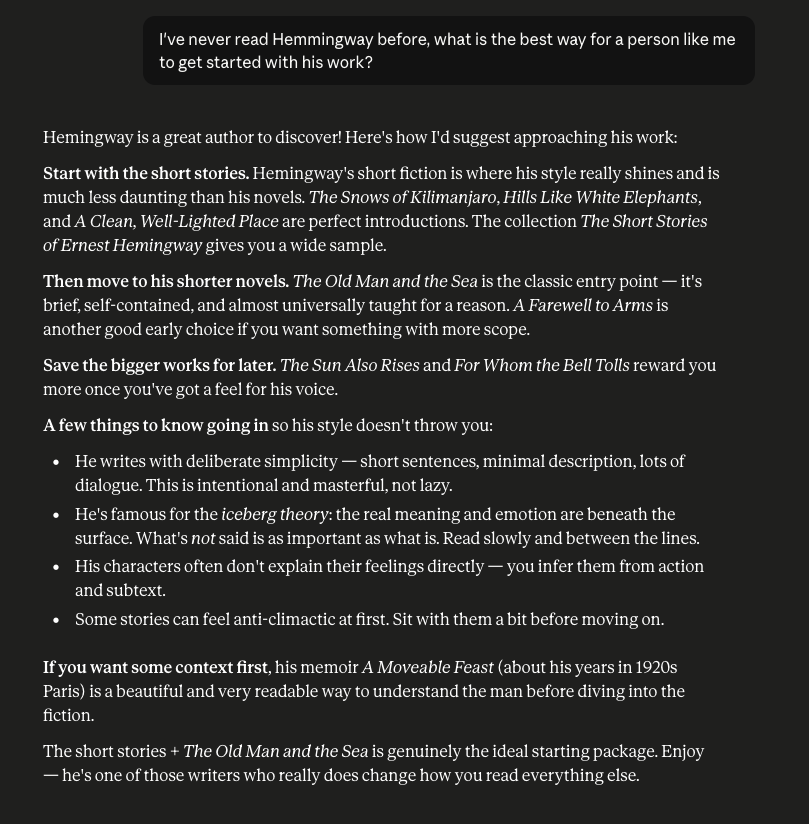
This is the part Google can't quite do. Google would have given you links to 20+ websites with names like "10 Best Hemingway Novels for Beginners." You would have clicked one, scrolled past the ads, and gotten a list. Instead, this AI thing gave you a considered answer that sounds like a recommendation from a knowledgeable friend.
That's the first thing. It's a better version of looking something up. Already worth the price of admission, which in this case is zero dollars. Bye bye Google.
2. Custom Answers for You
Now type this:
Which of the authors I read are most like Hemingway, and which Hemingway works are most like the things I like best about the authors I read?
The machine will probably ask you who you read. That's a good sign — it means it's not making something up about you.
Here's what it did for me:
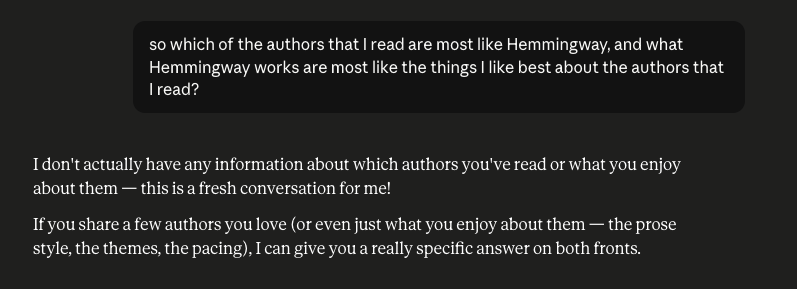
Now you can tell it three or four authors you actually read, or what you tend to like in a book. Go ahead. Just type it however you want. Then watch what it does.
Here's mine:
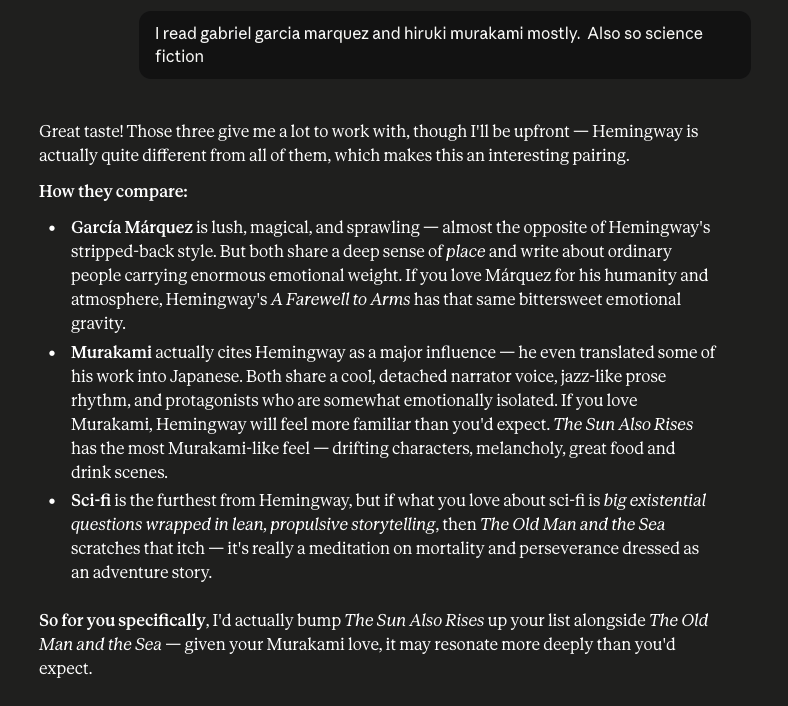
What seeing is something Google has never been able to do. You gave it some names, and it built a comparison specifically for you — finding the resonances, picking the Hemingway books closest to what you already love, telling you what's different and why that might matter.
This is past Google entirely. This is the machine taking what you told it about yourself and shaping the answer around you. It's the kind of thing you used to have to call a literate friend on a Saturday afternoon to do.
Notice how it felt. The machine sounded like it understood you. That feeling matters. We'll come back to it.
3. Your New Thinking Partner
This one is different. The first two were questions with answers. This one is the kind of half-formed thing you'd usually chew on alone for a week.
Type something like this, or your own version:
I want to start exercising again, but I have a bad knee and I don't like gyms. What are my actual options?
Here's mine:
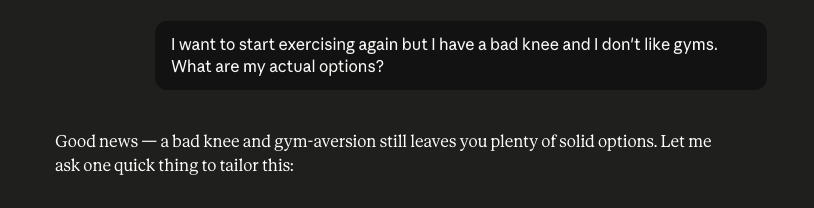
You can also play with this – it is the the shape of your question (this is called a "prompt" that matters: I'm trying to do (insert your something here), but I'm stuck on a specific thing. Help me think it through.
The machine probably didn't just hand you a list. It might have asked what you're trying to accomplish — lose weight, build strength, just feel better. It might have offered a couple of buttons to tap. It's narrowing with you. It's not answering yet; it's figuring out what the question actually is.
It did that for me and here's what happened (you can see the questions it asked me and my answers on the top right):
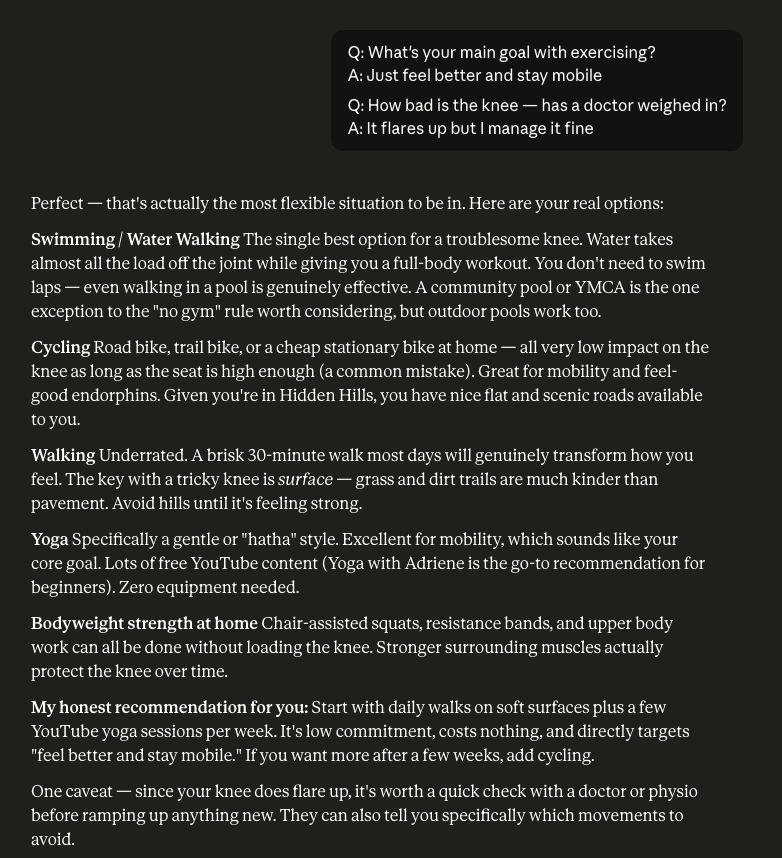
This is the part that's hard to explain to someone who hasn't done it. We brought a vague problem. The machine helped us turn it into a specific one. And then it gave you something useful — probably more useful than what you'd have gotten from a week of half-thinking about it on your own.
Here's the move worth learning. After it gives you its first answer, push back. Try one of these:
That's helpful, but I'm specifically worried about my knee. What changes if that's the main thing?
What am I not thinking about that I should be?
If you had to pick one thing for me to start with, what would it be?
The first answer is almost never the best answer. It's the starting place. The conversation is where it gets good. Most people who've used AI once and decided it was overrated did so because they typed one thing, read the answer, and stopped. They didn't realize they were in a conversation.
You're in a conversation. Use it.
What you just did
You moved through three different ways this AI thing is useful, in roughly fifteen minutes:
- It can give you a better answer than ten blue links.
- It can shape that answer around what you tell it about yourself.
- It can help you think through something you couldn't quite articulate when you started.
The third one is the part that's going to change things. Most people will use AI for the first two and miss the third one entirely, the way most people used Google for years without ever learning the search operators. The thinking-partner part is where this stops being a fancy search engine and starts being something genuinely new.
The catch
Here is the one thing you're going to miss once you stop using Google: Google would tell you or at least it was obvious when Google didn't know the answer. That doesn't happen with AI tools… None of them.
The AI was confident the whole time. About Hemingway, about your reading list, about your knee. Much of what it told you was probably right. Some of it might have been wrong in ways you couldn't catch — a confident recommendation for a book that's actually a terrible starting point, an exercise suggestion that's bad for your specific situation, a comparison between two authors that sounds insightful but wouldn't survive thirty seconds with a literature professor.
You have no way to tell which is which yet. Neither does anyone else, really. That's the part of this that everyone — including the people building these things — is still figuring out.
So: enjoy the machine. Use it for things where being wrong is a small problem. Be careful with it for things where being wrong is a big problem. Notice when it sounds like it understands you, and remember that the sounding-like is doing a lot of the work. The understanding part is more complicated than it looks.
You just had the experience my book is about.
But for now: you've used it. You're not behind anymore. Go ask it something else.