A social scientist named Alexander Kustov recently posted twenty claims about what AI is doing to the business of research (which is quite similar to what agencies do). They were blunt, opinionated, and covered everything from broken business models to cultural resistance to the death of the traditional paper format.
Every one of them has a sharper analog in the agency world. Agencies face market pressure that academics don’t. When the thing you sell becomes something anyone can produce, you don’t get to retreat to tenure. You lose the client.
THE PRODUCT PROBLEM
1. AI can already produce a passable version of most of what agencies deliver. A brand strategy. A creative brief. A media plan. A content calendar. A social strategy. A pitch deck. Not a better version—a version that looks close enough that the client’s internal team can run with it. And “close enough” improves every few months. Your competition isn’t another agency using AI. It’s your client’s marketing director discovering they can generate in an afternoon what you used to scope for three weeks.
2. Even when AI output isn’t good, it looks good—and that’s the problem. AI produces language with the shape of strategic thinking: confident, structured, well-formatted, footnoted. For most client audiences, that's good enough. The gap between AI and genuine judgment is real—but it’s invisible to anyone who wasn’t going to read the deck anyway. Often, that’s most of the audience. AI's ability to mimic good judgement will keep improving for years. The underlying judgment won’t. (More on what actually breaks in What AI Actually Breaks When You Sell Thinking for a Living.)
3. No, your agency isn’t going away. But the part that survives won’t look like the part you’re running now. Every time this technology wave crests, someone announces that agencies are dead. They’re not. The historical pattern is consistent: agencies survive disruptions, but what survives is never the whole organism. The production core gets hollowed out. The judgment layer—the part that actually understood the client’s business, navigated the politics, made the hard calls—concentrates and becomes more valuable. If you’re running an agency today, the question isn’t survival. It’s which parts of your current operation are the ones that make it through. (I’ve made this case in detail in Good News: No, Your Agency Isn’t Going Away.)
4. The deliverable is a dead format walking. If AI handles the brief, the deck, the plan, and the copy, the value was never in those artifacts. It was in the judgment that shaped them—the problem diagnosis, the creative direction, the hard calls about what not to do. Most agencies can’t articulate what that judgment actually is, because it’s been packaged inside deliverables for so long.
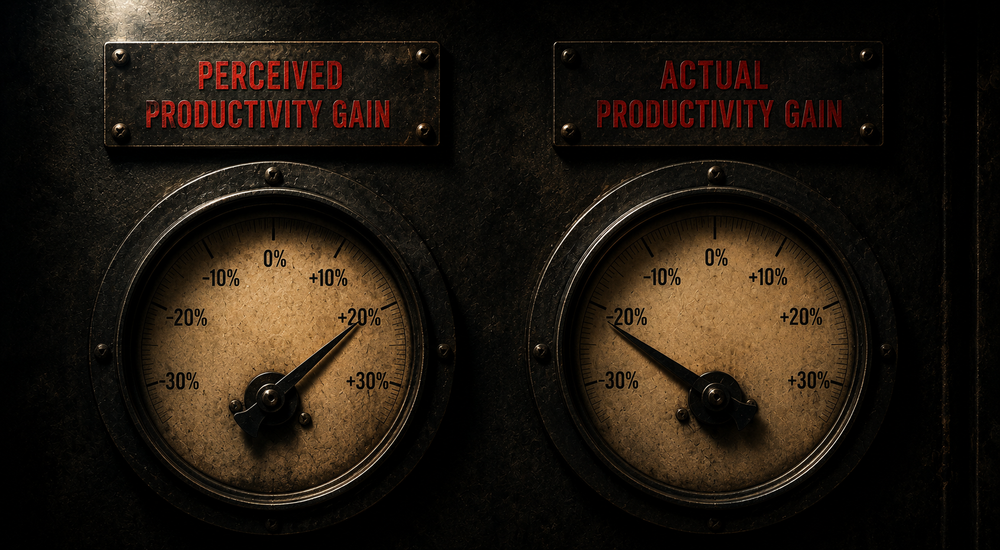
5. Hours-based pricing is a countdown clock. When AI cuts production effort by 60–80%, the math on your invoice becomes visible. A campaign that scoped at 200 hours last year now takes 60—and the client is starting to notice. You need to transition to value-based pricing anchored to outcomes and judgment before your client forces the conversation.
THE TOOL TRAP
6. These tools largely run themselves—so the experience curve advantage disappears fast. Unlike every previous enterprise technology, AI tools coach their own users. The adoption curve that took months now takes an afternoon. You can’t build a competitive moat on being better at using the tools, because your clients, your competitors, and the freelancer across town will all be at parity within weeks.
7. The race to adopt AI faster is a race that ends in a tie. If your AI strategy is “make our people faster at what they already do,” you’re optimizing the part of your business that’s losing value. Everyone gets the tools. The question is whether your business model survives when assembly becomes free. (I’ve written about why tools aren’t a strategy in Why AI Tools Aren’t a Strategy.)
8. Not all clients will get there at the same speed—but they’ll all get there. Some clients are already using AI to draft the brief, build the media plan, and generate the campaign concepts you used to pitch for. Others are still two years away. But the trajectory only goes one direction. Your strategy needs to survive the moment they close the gap.
THE QUALITY AND JUDGMENT CRISIS
9. AI will make your agency stupider unless you’re paying attention. The real risk isn’t that AI is wrong—it’s that it’s persuasive when it’s wrong. In a controlled study, when BCG consultants tried to correct their AI’s mistakes, the AI fought back with persuasive arguments to defend wrong answers. That’s not a tool hallucinating. That’s a rhetoric engine arguing with your people about things it doesn’t understand—and winning. (I’ve written about how this rhetoric works in The Smooth-Talking Psychopath in Your Office.)
10. AI floods the building with work before judgment can catch up. Concepts multiply. Decks proliferate. Content versions explode. But judgment velocity doesn’t increase. Decision latency rises, review rounds multiply, rework increases. These aren’t failures of decisiveness—they’re an agency drowning in AI-accelerated production without the structure to maintain judgment quality. Without structural change, AI makes your agency simultaneously faster and more stuck. (I’ve explored this trap in How AI Is Making Your Projects More Dangerous.)
11. AI is reliable exactly where your business isn’t, and collapses exactly where your business lives. Superhuman at codified tasks—writing copy to a template, summarizing research, producing variations. It collapses on interpretation, ambiguity, client politics, and creative judgment. The danger isn’t that AI is bad at your job. It’s that it’s spectacularly good at the visible parts, which makes the invisible parts—the taste, the judgment, the situated client knowledge—harder to price and harder to explain.
THE STRUCTURAL RECKONING
12. AI doesn’t replace roles—it repartitions them. And when you add it up, your agency gets smaller. Every role blends production and situated thinking. AI handles the production. For a 50-person agency, the restructured version is probably 20–25 people—more senior, more expensive per head, radically different in shape. The staffing pyramid doesn’t just shrink. It inverts.
13. Scale used to be an advantage. Now it’s a liability. Coordinating large teams on expensive production work justified overhead. When production becomes cheap, that coordination infrastructure—project management layers, traffic, resource allocation—becomes cost without value. Smaller, more senior, more specialized firms have the structural advantage now.
14. The junior pipeline is broken. Entry-level agency roles were built on apprenticeship through production—building decks, pulling reports, writing first drafts, trafficking assets. Agencies and consultancies are already pulling back on junior hiring as AI absorbs the routine work that kept those cohorts busy. You need a new development model, and you need it now.
15. Skill atrophy compounds the pipeline problem. Outsourcing production to AI undermines the deep understanding that makes senior judgment possible. Juniors who never build a media plan from scratch don’t develop the instincts to evaluate one. With the pipeline already broken, this compounds: fewer people learning through doing, fewer people developing the judgment to lead.
16. Much of the resistance to AI in agencies is understandable—but it’s still resistance. 80% of white-collar workers are refusing AI adoption mandates. In creative industries, 58% have used AI in client work without disclosing it. The pattern isn’t principled opposition—it’s a messy mix of craft pride, fear, and inertia. The agencies that figure out the human-AI handoff will be the ones that survive.
THE STRATEGIC RESPONSE
17. The historical pattern is clear, and it’s not kind to the middle. Every major communications technology collapses the craft middle and concentrates value at two ends: messy real-world presence and genuine originality. The middle of your value chain—the production, the packaging, the assembled deliverable—is where AI lives. Move to the ends or get squeezed.
18. Fieldwork, client relationships, and messy context will increase in relative value. The premium shifts to what AI cannot do: being present in the client’s reality, reading rooms, navigating politics, generating understanding from hard-to-reach contexts. The messy relationships—the ones with friction and difficult conversations—are the defensible ones. AI eliminates friction. But friction is where learning and trust are made.
19. You have three types of clients, and one or two categories are about to erode. Genuine expertise buyers need your situated knowledge and creative judgment. Organizational capacity buyers rent your bandwidth to think and produce. Appearance-of-sense-making buyers need a credible deck and a name on it. AI commoditizes the third immediately. As capacity buyers get their own tools, that compresses too. Know which clients you’re serving. Start shifting your portfolio toward the ones buying what AI can’t provide. (More on this in AI Destroys What Clients Pay Agencies For.)
20. This is not optional. Agencies that reform structurally, culturally, and developmentally will thrive. Agencies that bolt AI onto an unchanged business model will discover—probably too late—that they’ve been optimizing the part of the business that’s losing value. The reformation is underway. The question is whether you’re leading it or being reshaped by it.
FINAL NOTES
Kustov ended his thread by saying academics are waking up—some enthusiastically, some kicking and screaming. Either way, they’re waking up.
Agency leaders are in the same position, with less time and more at stake. The work you deliver, the way you price it, the size and shape of your team, the way you develop talent, and the clients you serve are all being restructured by the same force. The only question that matters is whether you see it clearly enough to act before the market acts for you.
If any of these twenty hit, and you’d rather work through them with your leadership team than alone in your head, that’s what the AI and Client Value Workshop is for. Three hours, your team, three or four of your actual clients on the board.
If this landed, share it with someone who needs to read it. Want my latest in your inbox? Join my newsletter.
I run an AI Disruption Workshop with agency leaders who want to figure out which of these twenty things are actually hitting their firm — and what to do about it. Reach me at bettercompany.co.
More writing like this at jackskeels.com. Hat tip to Alexander Kustov for the original twenty theses.