In late May, on a video link to a banking conference in Sydney, Sam Altman said he was “pretty wrong.”
Not about everything. But wrong about the one thing he’d spent two years selling as inevitable: that AI would gut entry-level white-collar work, that whole categories of jobs were on their way out, that hiring a human was starting to look like a quaint habit. He’d warned back in June 2025 that entry-level roles were at serious risk. At the Commonwealth Bank of Australia event, he upgraded that to “delighted to be wrong.”
And if you run an agency, you deserve a more specific eulogy than most. Back in 2024, Altman told the authors of the book AI First that AI would soon handle “95% of what marketers use agencies, strategists, and creative professionals for today,” easily, instantly, and at almost no cost.
Ninety-five percent. Not transformed; gone.
A precise number, tossed off casually, that told a few hundred thousand agency owners their entire business was a rounding error away from gone. Around the beginning of the year, I made a contrary calls about both his broad statements and more specifically, the agency case, in a piece I called, Good News: No, Your Agency Isn’t Going Away. Not because I’m a better soothsayer than Altman; I’d be wary of anyone who does this for a living, this writer included. I wrote it because the structure of how work works told me his math was wrong.
What Sam Altman didn't understand is that today's AI won't replace the Judgment Layer
But “he was wrong” is the least interesting true thing you can say right now. The change coming for knowledge work is real, and it is large. But you need to understand what it is and what it isn't.
Here’s Sam's original math, as best I can tell, whether or not he’d put it this way:
- Take a job.
- Break it into tasks.
- Show that a model can do each task faster and cheaper than a person can.
- Multiply across the economy.
- Conclude that the people are surplus.
And it's only true if...a job is a stack of tasks. It's not.
Every piece of knowledge work is two different things braided together: assembly and judgment. Assembly: the executing, the drafting, the producing, the grinding of a thing from rough to done. Judgment: the branching points, the noticing of what’s missing, the call about which of three plausible directions doesn’t detonate in six months.
Assembly executes. Judgment chooses. They alternate all day, inside the same hour, often inside the same head.
AI is genuinely extraordinary at Assembly
That half of his forecast was, in his own words, “roughly right.” Models draft, summarize, and generate at a speed no person can touch.
But making assembly cheap doesn’t make judgment disappear. It does the opposite. When assembly was expensive, judgment hid inside it; you couldn’t see how much of a senior person’s value was choosing rather than producing, because the producing took so long it camouflaged the question.
Make the producing (assembly) nearly free and the question gets loud. The only thing left that’s scarce, the only thing that doesn’t compress, is the deciding, the judgment. It sounds like, “...actually, that’s the wrong problem, and here’s the one we should be solving.”
That’s not a job category or a role. It’s a layer that runs through every role, top to bottom, which is exactly why it never arrived as a tidy wave of eliminated jobs. You can automate a task. But you can’t lay off a layer.
I'm old and have watched this stuff since the age of punched cards. Every technology that ever collapsed the cost of producing things ran the same play: it hollowed out the middle of the work and pushed the value to the two ends, toward the original judgment at the front and the human presence at the close. I call these the human high ground.
The printing press didn’t kill authors; it killed scribes. The assembly line didn’t kill engineers; it killed workers who did repetitive tasks. AI is running the identical playbook on knowledge work. The assembly middle thins. The judgment ends thicken.
Here's what happens today: you ask a AI for the deck and it produces a beautiful deck: clean structure, crisp copy, defensible-looking numbers. Flawless assembly. And it’s confidently selling the wrong strategy, in twelve immaculate slides. It needs you, or someone who can make a judgment call about what the deck was even for. Work gets faster. The being-right did not.
Our errors arrive polished better than ever.
Sam's Mea Culpa
Asked why his prediction missed, Altman reached for “the human part” of work, which, he said, turned out to be more resilient than he suggested. He admitted, a little sheepishly, that he’d tried handing his own Slack replies to an AI and then quietly gone back to writing them himself.
The most-quoted AI forecaster alive reverted to doing it by hand.
The Third Part of Work
Sam isn’t wrong that the deliverable is getting cheap. But notice what isn’t in the 95%. Our organizations produce work for someone, the client. There's Assembly, and teh Judgement that one needs with it. And then there is the Client, the Why We Are Doing This. The knowing which problem the client actually has. Sitting in the room when they can’t quite say it. Reading the politics of who has to be convinced. Earning enough trust to tell them the thing they don’t want to hear. None of that lives in the deliverable. It lives in the relationship. I call it the Structure Layer.
Like Judgement, this is the part of knowledge work that was always undersold, because it was tangled up in the hours. When the assembly took weeks, you billed the relationship through the deliverable and let the deliverable take the credit. AI just called that bluff. As the deliverable falls toward free, the value doesn’t vanish; it relocates to where it always actually sat: upstream, closer to the client, in the judgment about what’s worth making and the relationship that lets the call stick.
That brings me to one of Sam's other, somewhat more silly prognostications: musing on the inevitability of the “one-person billion-dollar company,” something I took apart in The Myth of the One-Person Billion-Dollar Company:
More Altman-math: if the machine can produce everything, surely one person can run it. It forgets that someone still has to make ten thousand judgment calls a year the machine can’t, and hold the relationships those calls depend on.
A Few Real AI Realities
I believe that the companies in real trouble aren’t the ones that do “creative.” It was unfair to pick on agencies in the first place. If your value proposition was producing a competent thing competently, repeatedly, then Altman’s 95% is pointed straight at you, and he’s more right than you would like. If your value was knowing the client well enough to produce the right thing, the floor under you just rose.
Regarding the workforce, the current data backs the shape of change but not the panic. The Yale Budget Lab found no meaningful change in unemployment through March 2026 for workers in high-exposure jobs; three years after ChatGPT, the great culling hasn’t shown up. The tech layoffs are real, north of 115,000 this year, but read the footnotes: much of it funds the capital expenditure on the very AI that was supposed to do the replacing.
And the frozen hiring everyone pins on AI is mostly a quits problem; when workers stop moving out of fear, replacement hiring falls on its own, even when nobody loses a job. I walked through that mechanism in The Big Lie about AI and Today’s Job Market (and Who’s to Blame). The market didn’t lose the work. It lost its nerve.
A Challenge for Leaders
And here’s the part that should worry a leader: believe in the job-pocalypse and you stop hiring and training juniors; why build a layer you’ve been told is doomed?
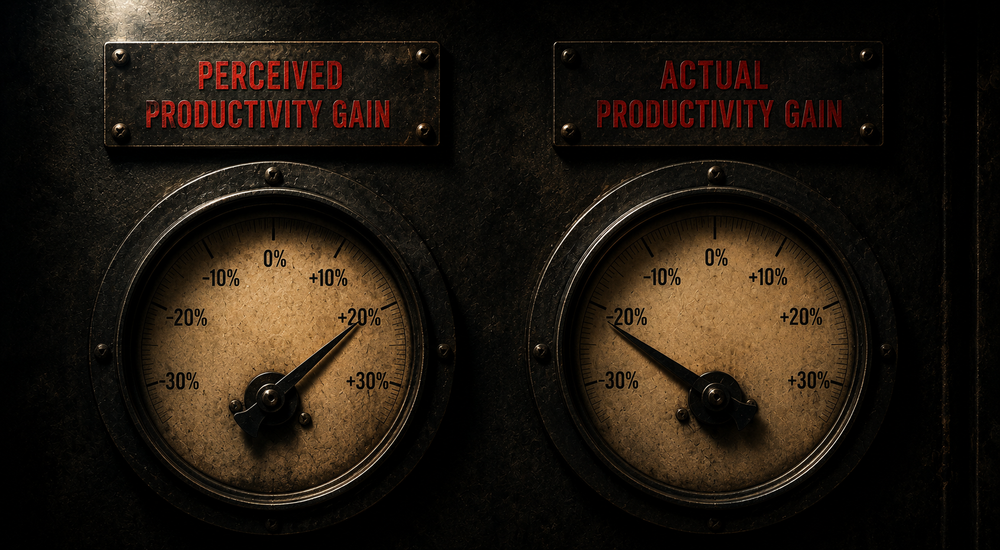
But juniors are how the judgment layer gets built in the first place. A randomized study this year by Shen and Tamkin, out of Anthropic’s own fellows program, found that developers who leaned on AI to get through unfamiliar work finished faster and understood less; their grasp of the concepts, their ability to read and debug, all eroded. Productivity is not competence.
So the Altman-like prophecies, once believed, quietly defund the pipeline that produces the one scarce thing, judgment, that it was wrong about. We risk manufacturing tomorrow’s shortage by acting on today’s myth.
Relax,...and get to work on the hard part
Altman’s reversal isn’t a sign that the danger passed; it’s that the danger was always misdescribed. The whole job of leadership over the next few years is to see the shifts clearly inside your own organization, and to move your people, your pricing, and your promises to the right side of it.
That is harder than either story you’ve been sold. Harder than “AI changes nothing,” and harder than “AI does everything.” It asks you to think, seriously and structurally, about your own business, at the exact moment the loudest voices (including the largely judgment-free AIs) are offering to do the thinking for you.
The leaders who come out ahead won’t be the ones who guessed right about AI. They’ll be the ones who did the unglamorous work of understanding it: what it makes cheap, what it makes precious, and how that reshapes what they sell and who they are to the people they serve.
Jack Skeels is CEO of Better Company and author of Unmanaged. He works with agencies and knowledge-work organizations on the structural changes underneath performance — not the tools, but the business model, the client relationships, and the organizational and process design. More at bettercompany.co