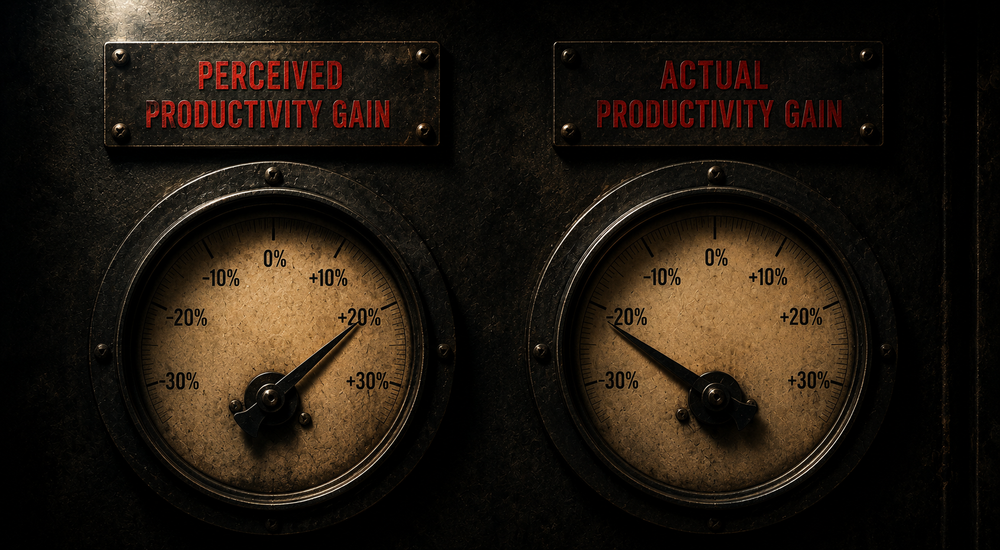
Every organization can now say they're using AI. Far fewer can show that it's actually making them better. That's the next frontier. Not more tools. Not more training. Evidence.
The Mirage of Adoption
Adoption metrics are comforting. They tell you how many people are using AI, how many pilots are running, how many prompts were written. But those numbers rarely reveal progress. They show activity, not improvement — motion, not evolution.
Without evidence, leaders can't see whether AI is accelerating alignment and learning… or just amplifying noise.
What Evidence Really Shows
When captured well, evidence exposes how collaboration is changing:
- Where decision loops are shortening.
- Where rework and coordination overhead are falling.
- Where creativity and reuse are compounding.
- Where teams are getting sharper — not busier.
This isn't about tracking tasks; it's about seeing the system adapt in real time.
Nine Ways AI Can Make You Better
Across our client work, we see nine consistent pathways through which AI improves collaboration and performance:
- Retrieve – Surfaces the right knowledge at the right moment.
- Draft – Produces first versions, turning blank pages into starting points.
- Refine – Improves quality and consistency, reducing rework.
- Sense – Detects emerging issues, patterns, or opportunities.
- Compare – Surfaces and contrasts options to strengthen judgment.
- Diverge – Generates creative alternatives and challenges assumptions.
- Coach – Prompts better framing, reflection, and decision quality.
- Orchestrate – Coordinates timing, tasks, and communication.
- Synthesize – Captures what's been learned so the next project starts smarter.
These are the nine ways AI helps organizations not just produce more, but learn faster. They are also measurable — the basis for real evidence of progress.
The Real "Why" of Measurement: Evidence Enables Effective Action
Measurement isn't the finish line; it's the feedback loop. Once you can see where collaboration is improving, you can:
- Act — invest where lift is already occurring.
- Adapt — evolve roles and rituals to reinforce what works.
- Reform — redesign processes and even business models around the new flow.
Evidence turns experimentation into evolution.
The "Why" of Pods: AI Adaptation Unencumbered
Traditional structures stifle collaboration and change because of strong management, structured hierarchy, and chaotic effects — your AI initiative must overcome all of this inertial and rigidity in process and structure.
Pods, by contrast, are small, adaptive systems:
- They integrate multiple skills in one unit.
- They flex and re-form around changing goals.
- They're measurable — you can see how collaboration, learning, and AI use are compounding week by week.
Pods unleash AI-driven change and adaptation by relaxing role, process, and structural expectations.
The New Competitive Edge
The future of AI-enabled work won't belong to the organizations with the most models or automation. It will belong to those that can see, measure, and improve their own collaboration in real time — those that treat AI as part of a learning system, not a tech stack.
Evidence enables effective action. Action enables adaptation. And adaptation to better ways of working is what builds truly better companies.