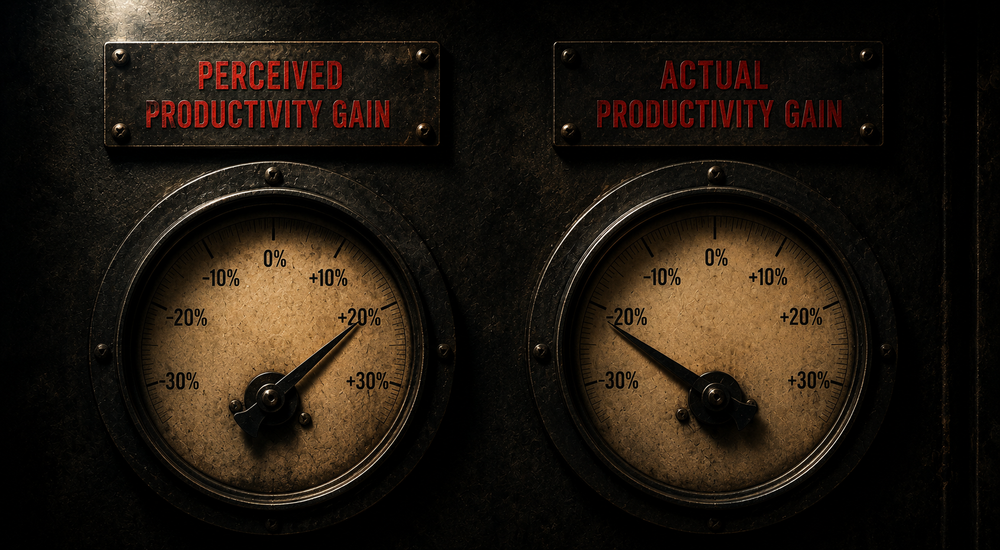
Why Agentic AI Won't Replace 80% of Knowledge Work
Forty years ago (yes, I'm that old), I was given a magic opportunity due to my success running an extremely challenging project: A 3-month apprenticeship at Digital Equipment Corp's AI Research Lab in Concord, Mass. It was a sparkling world filled with promise…at least until I opened my mouth and pointed out that much of what they were calling "AI and Expert Systems" was just plain old programming.
Back then, expert systems promised to wipe out whole professions. Sound familiar? These efforts collapsed under real-world messiness. Today's "agentic AI" is being hyped as the end of knowledge work — autonomous agents that can plan, act, and replace 80% of what people do. But scratch the surface and you'll find the same old problem: it's still just automation, with all the same fragility.
The real story isn't replacement. It's recomposition — and organizations that don't redesign how collaboration works will drown in error and noise.
1. Agentic AI = Automation With a Twist, Not Magic
Agentic AI can chain tasks, call APIs, and "look busy." At its core, though, it's still automation wrapped in an LLM. That means it inherits all the old limitations: brittle planning, lack of grounding in context, and error cascades that humans still have to clean up.
We've seen this movie before: expert systems in the 1980s promised to replace doctors, lawyers, engineers. They collapsed because the real world is too fuzzy for rigid, rule-based automation. LLM-driven agents are flashier, but they hit the same wall. LLMs changed that, yes, but only part of it, and not the hardest parts.
2. Knowledge Work ≠ Tasks
The "80% eliminated" story assumes knowledge work is just the sum of observable tasks. But it is not. That's why AI failed the first (and second) time. But tasks (summaries, drafts, reports) are the linguistic layer — easy to automate. The meaning layer — alignment, judgment, trade-offs, trust — is where the real value lies. And that's precisely where agentic AI fails, because meaning comes from shared human context.
3. Automation Changes the Mix, Not the Whole Job
History shows that automation reconfigures work, more than it obliterates it:
- Spreadsheets didn't eliminate finance — they elevated analysts into strategists.
- CAD systems didn't eliminate engineers — it accelerated design cycles and let humans solve harder problems.
Agentic AI will consume low-value, repeatable fragments — but that only expands the space for higher-order collaboration, innovation, and human-machine partnering.
4. The Fragility Multiplier
Adding autonomy to LLMs doesn't make them robust — it makes them more brittle. A single wrong assumption in an agent's chain of actions can cascade into dozens of errors. This doesn't erase jobs. It creates new oversight, orchestration, and integration roles. The same thing happened with industrial automation: you didn't just replace workers, you added supervisors, maintainers, integrators.
5. The Real Story Isn't Replacement — It's Recomposition
Agentic AI won't drown 80% of knowledge workers. It will:
- Eliminate rote fragments,
- Destabilize old workflows,
- Make collaborative structuring more important than ever.
Organizations will need collaboration architectures — pods, rhythms, oversight roles — so humans and machines can complement each other without creating more drag than they remove.
Conclusion / Takeaway
Agentic AI isn't a tsunami sweeping knowledge workers away. It's a messy, brittle automation layer that forces organizations to get serious about collaboration and structure. The winners won't be the ones who chase the hype of autonomous agents. They'll be the ones who redesign workflows for resilience and adaptability — where AI is just another tool inside a system built for clarity, alignment, and flow.