For decades, business leaders have faced what I call the package software problem: Every enterprise system — ERP, CRM, CMS, PLM — carries an implied operating model. You don't just install software; you install someone else's idea of how your business should work.
In the package-software world, that model is visible, sometimes painfully so. It reveals itself during implementation, when the organization must make explicit choices about: Feature sets that constrain what the enterprise can and cannot do. Process models that prescribe how work moves through the system, usually based on some vendor's idea of "best practice." Predefined roles and permissions that decide who acts, approves, or even sees.
These choices make the operating model legible. You can see it being built, challenged, and negotiated into the fabric of how people work. Implementation was, in its own way, a deeply human act of reflection. But AI is different. Its operating model is hidden.
The New Invisible Architecture
AI systems, especially those mediated through large language models (LLMs) and agentic orchestration layers, encode their operating assumptions in statistical behaviors, prompt architectures, and retrieval policies. They are difficult to see because they are:
- Non-explicit. No schema or workflow diagram to inspect; the logic lives in model weights and emergent interactions.
- Dynamic. The operating model mutates with each fine-tune, RAG update, or agent-handoff rule change.
- Opaque by design. Even the builders cannot fully explain why a particular response or action emerged—the latent logic is non-interpretable.
- Recursive. As AIs invoke other agents or systems, their implied operating models compound through layers, producing emergent behaviors no one can easily audit or predict.
In this world, the enterprise operating model no longer sits in a configuration document—it resides in a constellation of prompts, weights, and invisible feedback loops.
What's Actually Happening
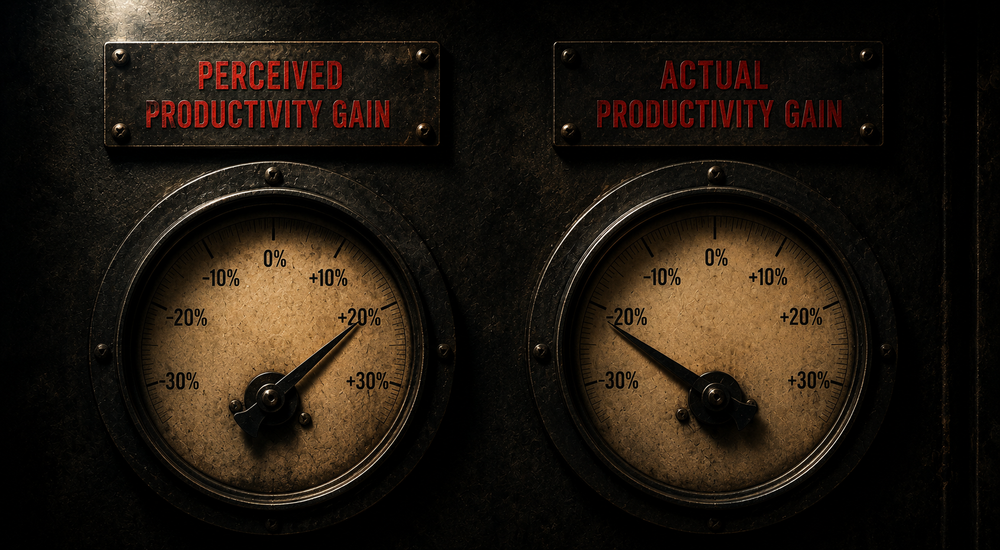
AI doesn't just automate work; it automates understanding. It quietly reassigns the organization's cognitive labor to machines, producing a system that looks sharper on the surface but is internally hollowing out.
- AI expands capability but contracts comprehension. Tasks get done more quickly, but fewer people understand why or how they're done that way. The organization's procedural fluency rises as its conceptual literacy falls.
- AI optimizes the known, not the knowable. It perfects existing patterns, but can't perceive when the pattern itself is wrong. The human ability to notice anomalies, which is the seed of almost every improvement, atrophies.
- AI replaces exploration with automation. When the machine "answers," curiosity becomes redundant. Workers shift from reasoning to monitoring; watching dashboards instead of questioning them.
- AI strengthens output loops but weakens learning loops. Organizational learning depends on the friction generated when errors are noticed, causes discussed, processes refined. As the machines increasingly take ownership of that friction, the learning cycle collapses.
The result is what I call the brittleness paradox. The Brittleness Paradox is when the organization becomes increasingly efficient, but decreasingly adaptive. It performs brilliantly right up until something changes—then fails catastrophically, because no one knows how it works anymore. It's an automated management system of competence without comprehension.
The Highly Addictive Cognitive Dependence: When AI Starts Thinking for You
Unless leaders deliberately ensure that their people understand how AI works and how to work with it, these systems will begin to push humans away—not by force, but by convenience. AI removes friction, and with it, the moments that once forced discernment. When the system gives you answers that sound reasoned, it quietly teaches you not to reason. When it seems to have already "done the thinking," it erodes the organization's collective capacity to think for itself.
That's how cognitive dependence begins. It's a modernistic factory where the Managers and the machine operators have surrendered all ownership save for watching the green lights that say the machines are still running, without any idea whether they're making the right parts.
Why This Matters
Historically, high-performing organizations have been self-correcting systems. Toyota's production system, quality circles, agile retrospectives—all relied on transparency of process and understanding. They worked because people could see and question how the system behaved.
As AI systems take on more of the cognitive and coordination load, they remove the visible signals that once allowed learning, reflection, and correction. The system may hum smoothly, but the learning loop closes to everyone but the machine.
So the danger isn't just that executives can't see how the business runs. It's that the organization loses the ability to know when it's wrong.
The AI-driven Business Imperative
AI is not just another productivity tool. It is a shift in who, or what, does the thinking inside your organization. If you want to preserve your company's capacity to learn and adapt, you must invest in understanding (human mastery of AI) as aggressively as you invest in automation.
Make AI legible. Make its assumptions discussable. Keep people inside the reasoning loop. Because if your teams no longer understand how their tools decide, and your leaders no longer understand how their business operates…then who, exactly, is in charge?