In his recent interview with The Economist, Elon Musk laid out a future so expansive it barely fit in the room. AI will exceed the sum of human intelligence by 2031. Humanoid robots will flood the economy with goods and services beyond what anyone could consume. Money won't matter by 2036. Work becomes optional. The Treasury just issues checks.
It's a seductive vision. It might even be directionally right about the technology. But it has an assumption buried so deep that Musk never acknowledges it, and I fear it is the one that matters most.
Inside AI's future lies a battle between its value for production versus that of control. And that will be a battle over what our future looks like.
The innovation advantage we used to have
There's a reason the free world won the Cold War, and it wasn't moral superiority. It was velocity. Distributed innovation, in teh form of millions of independent actors making bets, failing fast, iterating, outperformed centralized planning. This was because free markets generate more experiments and faster feedback loops than any command structure can. The Soviet Union couldn't keep pace with Silicon Valley because you can't five-year-plan your way to the semiconductor.
That logic held for decades. It held because the technology frontier was that of microprocessors, software, communications networks. They all rewarded the messy, wasteful, wildly creative process that open societies are structurally better at running. Authoritarian regimes could build big things (dams, armies, space programs), but they couldn't build new things fast enough to compete.
That asymmetry has probably flipped
AI is different. Yeah, I know everyone says that. In a lot of ways it isn't. But in some important ways it is.
It is not because of its power or what it will bring to us, and those areas are where Musk pretty much gets it right. It is different because it's diffusible in a way previous military-industrial technology wasn't. You don't need to independently invent the transformer architecture. You read the paper. You take the open-weights model. You clone the approach. Way easier than building nanometer scale chip fab from nothing.
China doesn't need to out-innovate the Bay Area. It needs to be close enough to do so without the friction that democracies impose on themselves: civil liberties, regulatory process, public consent, the argumentative slowness of self-governance.
This is why China is catching up or even leading the AI race. It is also why our government, no matter how much you despise the idea, should take an autocratic posture toward this technology. It may be one of the first big moments in the history of industrial policy where it makes sense for the government to get behind a technology.
And here's the part that should keep us up at night. The capabilities AI is best at — surveillance, information control, behavioral prediction, persuasion at scale — are capabilities that totalitarian regimes are structurally better positioned to exploit. Democracies can use them too, but with one hand tied behind their back. The social contract requires restraint. A system that doesn't need consent can deploy the full stack.
Harvard researchers have already shown that China's surveillance apparatus gives its AI firms an inherent advantage in domains like facial recognition — a feedback loop where mass surveillance generates training data that drives commercial applications that fund more surveillance. That's not a bug in their system. It's a feature.
The Hayek problem, updated
Here's the subtle part that really isn't part of our national dialog: the reason (Soviet, for example) central planning failed wasn't just political. It was computational. Friedrich Hayek's great insight was that the knowledge required to run an economy is distributed across millions of minds and can't be aggregated by any central authority. Markets solve this problem not because they're fair, but because the price mechanism encodes information that no planner could collect.
Few people outside of the finance and economics fields really understand that. The popular Zeitgeist that free societies are better is just a façade over what is really making them work: they are substantively more efficient.
AI changes the terms of that argument. It's quite possible that authoritarian regimes can use AI quite effectively to solve the central planning problem, or at least solve it a lot better. It does not need to be optimal, but just sufficient, then our capitalist society's advantage shrinks in comparison. And the question stops being whether our free society is better and starts being whether our advantage still matters.
That's the question Musk's vision doesn't ask. He skips straight from "the technology is coming" to "abundance follows." But abundance depends on who is defining it, and the power to define it accrues to whoever can deploy the technology with the fewest constraints.
The world as we know it
There's a useful parallel to the 1960s. That decade broke the postwar consensus politically, culturally, institutionally. What came after was genuinely different, not a restoration. The realignment took twenty years to fully resolve. We might be halfway through something similar now: a period where the old structures are cracking and the new ones aren't visible yet.
But the 1960s produced constructive rupture alongside the destructive kind. Civil rights legislation, new institutional infrastructure, expanded democratic participation. The old order broke, and something got built in the wreckage.
The question for this cycle is whether the construction phase happens at all, and in whose image. If AI's primary strategic value turns out to be control rather than production, then the future doesn't default to Musk's abundance. It defaults to whoever is best positioned to use the technology without asking permission.
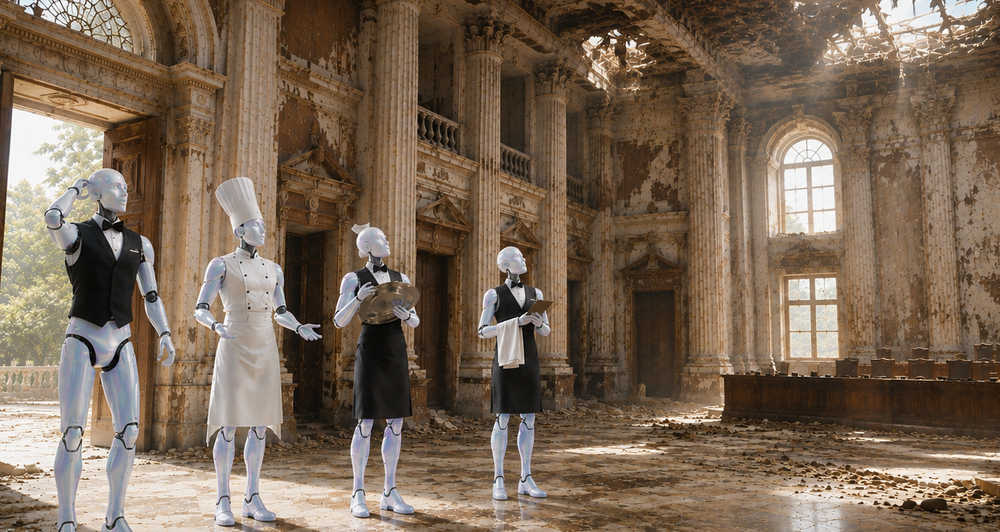
Musk frames the next decade as an engineering problem. Build the robots, scale the models, distribute the output. But the transition from here to there runs through exactly the kind of political, institutional, and epistemic crisis we're already living through. His abundance won't arrive in a vacuum. More likely it arrives in a world that's mid-demolition.
Whom will the robots serve?
The free world's historical advantage was never just faster innovation. It was that the messy, distributed, argumentative process of democratic discourse produced better maps of reality than top-down narrative control. If AI changes that equation — if it makes authoritarian systems computationally good enough — then Musk's vision isn't wrong about the technology. It's wrong about who benefits, and the potential shape of the world order.
Will Elon Musk save the world as we know it? Only if the world as we know it is still standing when his robots arrive.