
Speed has always been structural. AI just makes that impossible to ignore.
Most AI pilots return improvements somewhere around 10%. That's not nothing, but it's chump change compared to what's possible.
Last year, I ran a project with a large agency in London — a major, multi-element campaign. We cut span time by more than 50% and reduced labor costs by more than 30%. The difference wasn't better AI tools. It was a fundamental shift in structure.
That gap — between 10% and 50% — is the gap between accelerating action and fixing the system that governs it. And it explains why so many organizations adopting AI feel simultaneously faster and more stuck.
Action, Judgment, and Structure
To understand that gap, it helps to separate three things that organizations constantly blur together.
Action is what an organization does — producing work, shipping deliverables, responding to clients, executing plans.
Judgment is how the organization decides what actions make sense — interpreting context, aligning priorities, weighing tradeoffs, determining what's good enough to proceed. Judgment is largely a managing function: it lives in the coordination, alignment, and sense-making that managers and leads do across every level.
Structure is how judgment and action are connected over time — who is allowed to decide, how understanding is shared, where authority sits, and how work flows from one person or group to another.
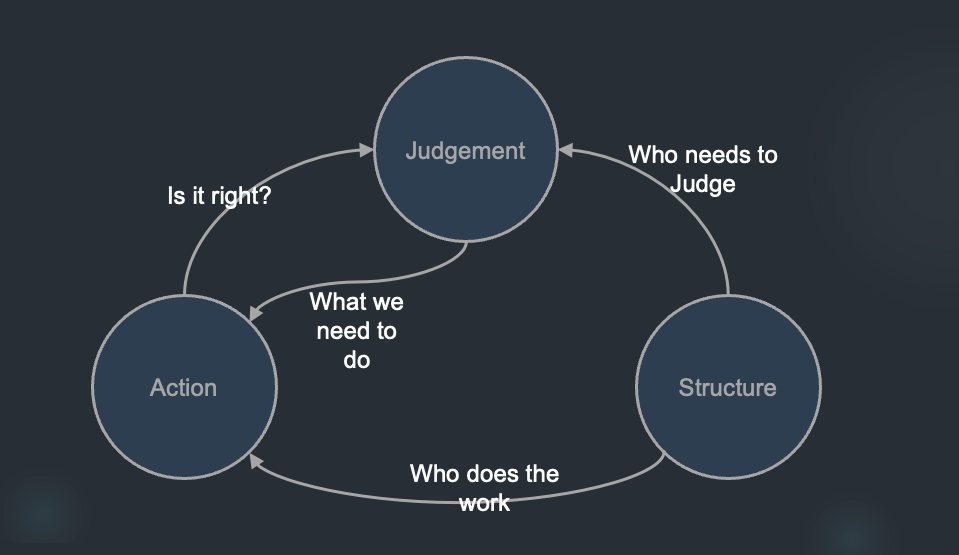
When these three are well aligned, action flows naturally. When they're not, work moves forward, stalls, and loops back. Every organization is managing all three, all the time. The question is whether it's doing so deliberately.
Action Is Rarely the Bottleneck
Most improvement efforts target action: better tools, tighter processes, more automation, fewer meetings. AI fits squarely in this tradition — it speeds up generation, iteration, routing, execution. But action has rarely been what holds organizations back.
Judgment is the bottleneck. And judgment cost doesn't scale linearly with organizational size. It scales super-linearly. Every additional person, team, or stakeholder doesn't just add one more judgment to make — it multiplies the coordination, alignment, and re-alignment required across the whole system. The geometry of judgment is combinatorial.
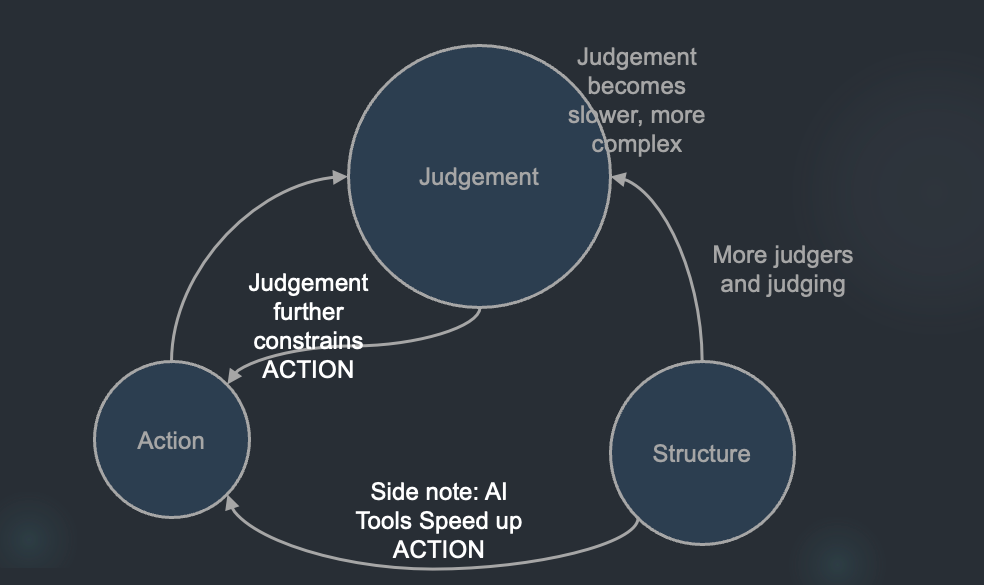
This is why AI, on its own, produces such underwhelming results. You can make action ten times faster, but if the judgment system is still fragmenting and re-forming at the same rate, you haven't changed throughput. You've just made the bottleneck more visible.
The Standish Group has spent decades documenting this. Their research consistently identifies decision latency as one of the strongest predictors of project failure. But decision latency is a symptom, not a cause. The cause is judgment overload — and the fix isn't faster decisions. It's reducing judgment sprawl.
An obvious objection is that AI will eventually automate judgment too. But organizational judgment isn't replicated by rhetorical pattern-matching — it's situated, contextual, and deeply human. It depends on reading rooms, navigating ambiguity, and negotiating meaning across people who see things differently. Anyone who's watched AI confidently bungle something straightforward knows how far it is from handling that. The reticular network of human decision-making in a complex organization goes well beyond what current AI can do, and betting your structure on that changing soon would be reckless.
Why Pods Work
Pods — stable, cross-functional teams assigned to a bounded body of work — are one of the most effective structural changes we've implemented. When you see them in action, you see fewer handoffs, tighter teams, less fragmentation. But what they're really fixing is the judgment bottleneck.
Pods reduce judgment decay. Keeping people on a stable body of work preserves context over time. Understanding stays warm. Decisions are grounded in a shared mental model rather than re-assembled from fragments.
Pods collapse judgment distance. In most organizations, judgment travels through layers — account teams, project managers, review committees — before it authorizes action. Each handoff introduces delay and distortion. Pods put judgment close to the work.
Pods constrain the geometry of judgment. As organizations grow, judgment coordination becomes combinatorial — managers judging managers judging managers. Pods create bounded spaces where judgment stays local. This prevents the super-linear growth in judgment cost that drives managerial bloat.
Pods rebalance judgment and action. Less re-judgment and re-alignment means more effective judgment bandwidth without more oversight. Action moves faster because judgment is already in place, not because it's bypassed.
Pods change managerial work. Managers spend less time trying to reconstruct thinking that already happened somewhere else in the organization, and more time on what actually matters — clarifying goals, resolving real conflicts, adjusting structure. Less wasted management.
Enjoying this article?
Get new articles delivered to your inbox — no spam, just ideas worth reading.
Structure First, Then AI
AI made action cheap. That exposed what was always true: judgment is the bottleneck. Not worker speed. Judgment — the quality, speed, and latency of decisions across the managerial system.
Structure is how you fix that. Structure determines how judgment forms, where it lives, and how much of it gets wasted. Change the structure, streamline judgment, and you unlock the speed AI is supposed to deliver. That's what last year's London project proved.
The same structural changes that made organizations faster before AI are the ones that make AI deliver on its promise. If you don't make them, your competitors will.
This is part of a larger body of work I've been calling the AI Reformation — exploring what it means that today's AI is rhetorical, not intelligent, and why that distinction matters enormously for how organizations lead, decide, and design work.
If you're a leader navigating this shift and want to think it through with someone who's been deep in it — I'm at bettercompany.co.
— Jack Skeels