
Should we stop hiring juniors?
That's one of the questions I hear and see a lot. It comes in many forms, but the real question is, "How big is this AI thing going to be, and how fast is it coming?"
I've been working on an answer, using a model built from thousands of actual agency job responsibilities, and a 282 AI agent repository that I used as a base model. What I've been able to suss out is a calculation of how many people an agency would need to deliver the same work, using AI at different levels of adoption. I did this so that I can model specific agencies based on their constituent departments, roles and people.
Why? Because technology adoption, and actually good management, both work better if you have a target. And the question is what a reasonable target should be for any given agency, and a given department within that agency.
The answer is somewhere between 48 and 25 people, starting with an agency of 60. So, 12 to 35 people under- or not at all utilized. Or less than that if you do very little.
Here's the way it shakes out. Of course, YMMV... a lot.
Sixty people walk into an AI transformation.
Imagine a 60-person agency. Same clients, same services, same workload. I change only how the work gets done. 60 people, 30 juniors, 21 mids, and 9 seniors.
Here's what my model produces:
Halfway there means serious AI adoption, but plenty of work still done the old way.
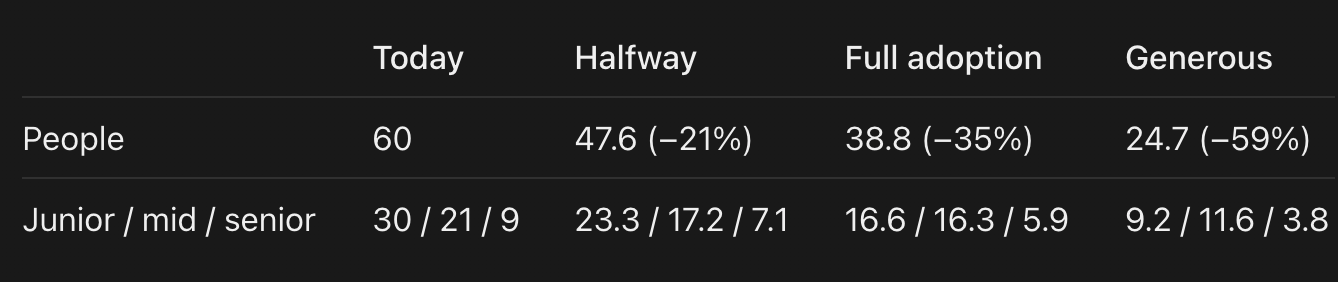
Full adoption means extensive use of today's AI capabilities, with the work reorganized around them.
Generous assumes substantially better AI tools and a shift to integrated pods that eliminate much of the coordination and management overhead.
Before you start preparing severance packages, please know that these are staffing requirements, not layoff recommendations. An agency that can deliver its current workload with 39 people could also deliver considerably more work with 60. Maybe that is additional work you get paid for...maybe not.
Obviously it won't affect all roles and departments the same, so I modeled a way to indentify displacement based upon my assembly-judgment model. (I'm also going to pilot this modeling in a more specific way with some select clients).
I took apart 423 agency jobs.
My model starts with 423 agency job postings, broken into 5,061 individual responsibilities. I classified each by seniority and by the kind of thinking involved.
Some work is assembly: gathering, producing, formatting, and organizing. Some is assembly judgment: making relatively bounded decisions with recognizable right answers.
Then there's contestable judgment (or battleground), where reasonable people (and models) can disagree, and situated judgment, where decisions depend on deep knowledge, in some form or forms, including understanding a particular client, market, or business situation.
AI is increasingly capable of the first two. It can assist with the others, but assistance isn't the same as accountability.
From there, I make four adjustments.
- First, AI absorbs some work, but I subtract the time spent reviewing and correcting its output. Workday's research suggests rework can consume about 40% of the time AI initially saves.
- Second, some (judgment) work moves upward. Midlevel people increasingly review AI production and take on judgment previously distributed across junior roles.
- Third, management and coordination shrink along with the organization. Smaller teams need less supervision, and if you add pods you can eliminate many of the handoffs between departments.
- Finally, I constrain judgment work by the hours people actually have available for concentrated thinking.
That last adjustment I'll explain in just a sec. But first, let's talk about the shape of your agency.
Goodbye pyramid. Hello diamond...or obelisk?
The traditional agency is a pyramid: lots of juniors, fewer mids, and a relatively small senior group.
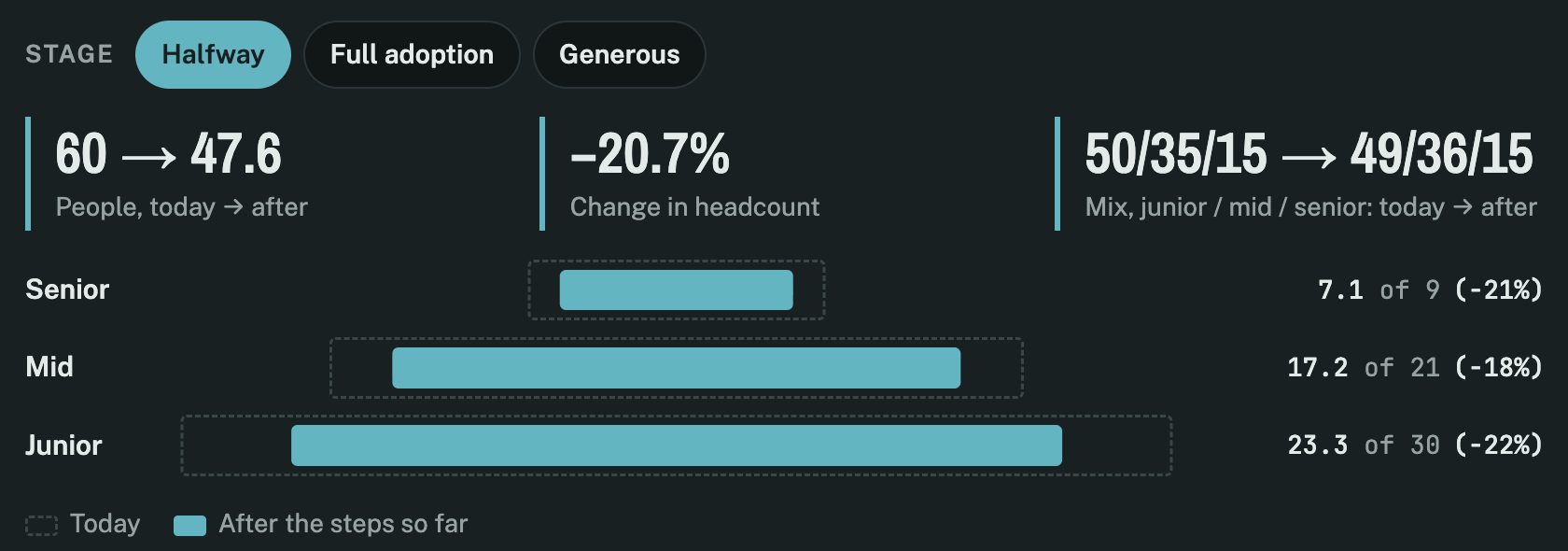
And as you'll see in the following sequence, AI takes a rather large bite out of the bottom. Here is the partial (halfway) adoption. You can see how the total headcount shifts, and I have also added percentage values on the top right, before and after.
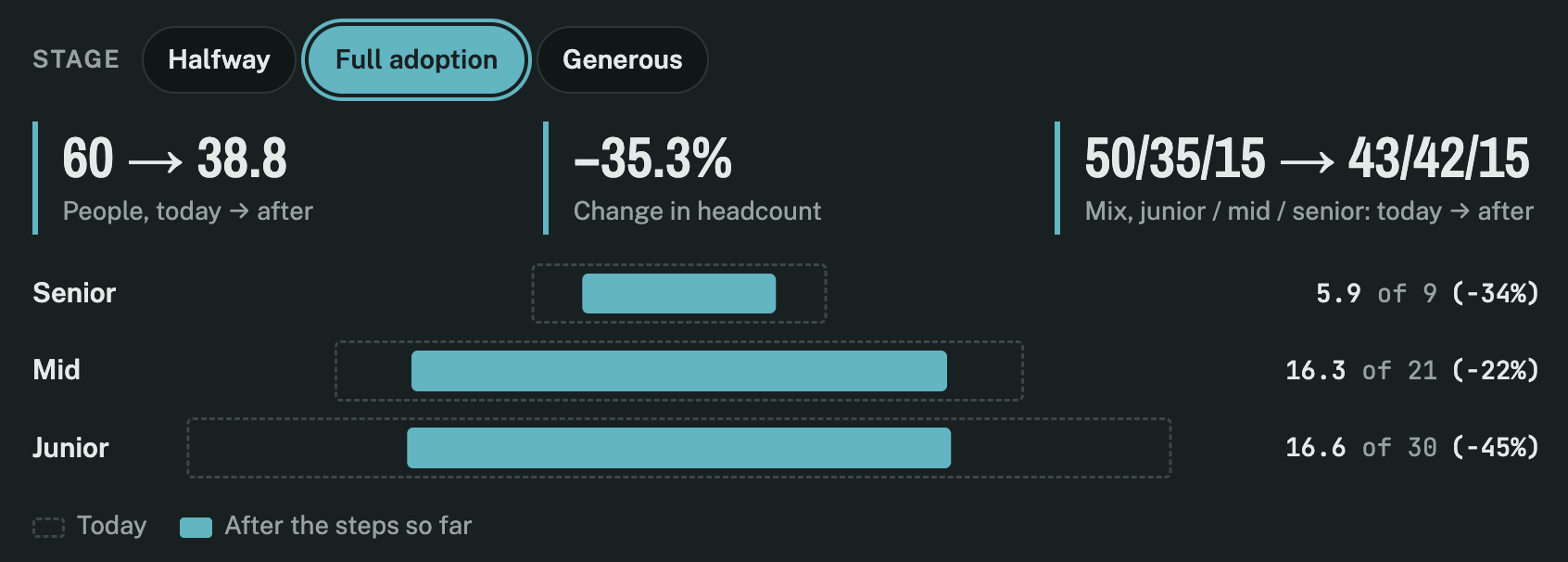
At my "full adoption", the 30 junior positions fall to about 17. The 21 midlevel positions become approximately 16. The 9 senior positions become 6.
And here is a "generous" or agressive model...though I suspect that you woudl not reduce the number of seniors so much for other reasons not built into this model:
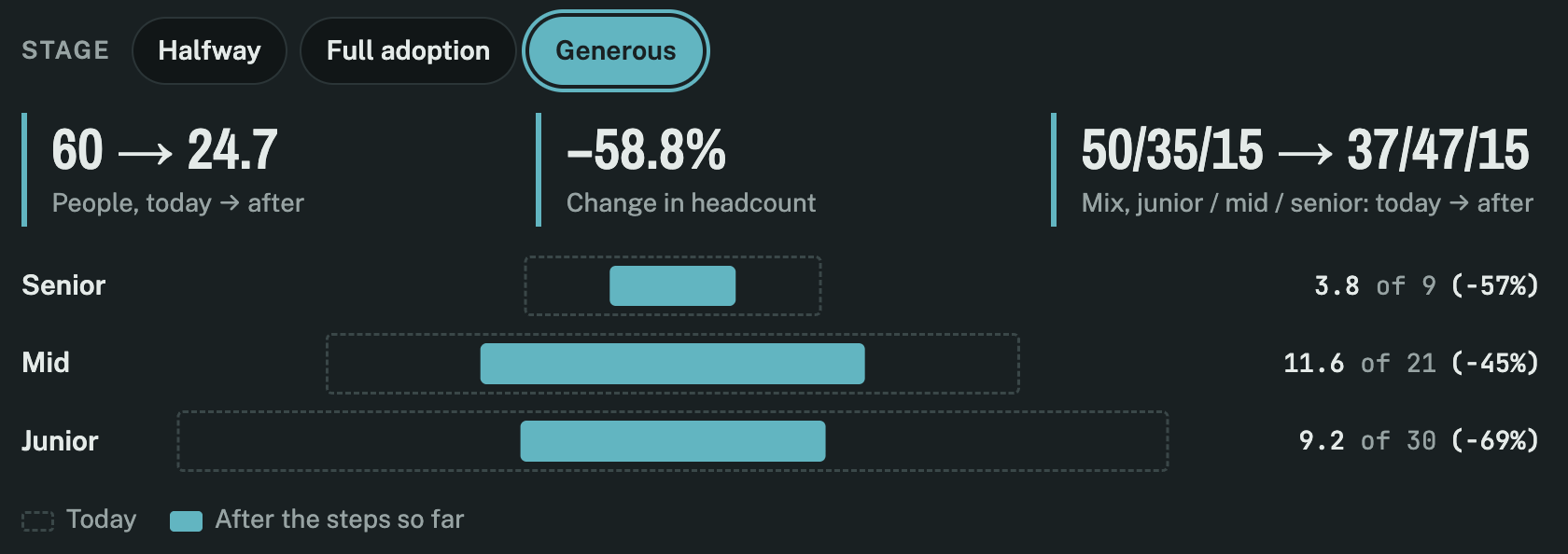
The middle is now the largest layer, and the pyramid has become a diamond.
Will our mids survive AI?
Yes. Because they're becoming the essential operators of an AI-enabled agency. They know enough to recognize good work, catch bad work, understand client context, and make the hundreds of judgment calls that turn AI output into something worth buying.
They're also close enough to production to operate the tools themselves.
Another way to think of tyhis is that the old agency needed lots of people to produce things and fewer people to judge them. The new agency has abundant production capacity and a shortage of judgment.
The economics are slightly less dramatic than the headcount reductions. At full adoption, headcount falls 31%, but employment costs fall about 25%.
The people who remain are disproportionately the expensive ones.
AI won't be your bottleneck...it will show up on Tuesday afternoon.
Yes, AI means fewer people. But quickly you run into a constraint that another AI model release or tool won't fix: human attention.
Judgment requires concentrated thinking. Not meetings, emails, status updates, or the dozen other activities that somehow fill an agency employee's day.
It requires actual flow time. And the bad news is that our data shows that those same mids that we will increasingly rely upon for judgment, are among the most flow-impaired in the whole agency. In my agency benchmarks, midlevel employees report about 2.5 hours of it per day.
Before AI. they have barely a third of their working day available for the thinking that matters. When the model requires judgment work to fit within those available hours. Even in the generous scenario, every staffing layer eventually hits that constraint.
Which leads to a rather interesting conclusion.
Once AI has absorbed most of the routine production, the next big productivity gain comes from organizational structure, not necessarily better AI.
Give your mids another hour of productive flow time and you've increased their judgment capacity by 40%. Just fewer interruptions, less coordination, and better-designed work.
For decades, agencies have treated organizational inefficiency (inefficient structures that typically result in interruptive noise and rework) as an unfortunate cost of doing business. AI is turning it into a competitive disadvantage.
Where does that leave your agency?
Based on publicly available information and also some more-private industry and agency insights, I would claim that most agencies haven't reached even the halfway stage.
Most agencies are "doing something" but that is not all those close to really using AI in an impactful way.
They've purchased the tools, encouraged experimentation, maybe formed an AI committee. They've added AI to the old organization.
And when someone saves three hours, those hours don't necessarily become three hours of productive capacity. They disappear into rework, scope creep, extra revisions, and the organizational slack that was already there.
The distance between your current staffing model and these scenarios represents both your exposure and your opportunity.
Following the money: the "AI discount"
I'm going to do a whole post on pricing and value inside of these models, but I feel like I need to mention just a few points.
The 60-person agency (using industry standards data) looked like this: $10.8M in fees, $7.3M in labor, a 33% margin before rent and overhead.
- Labor cost falls slightly less than headcount. At full adoption, the people who stay are the more expensive ones.
- Who keeps the savings depends on how you price.
- Billed by the hour: revenue drops, but margin % drops far less. The client gets the savings on total spend, plus some of the margin you had. This assumes that work does not expand, aka that you are not doing additional work for that client or other clients.
- Priced on the work: depending on how you do this sort of pricing, revenue can be more stable, and margin can go up by a little or a lot.
- What is a fair "AI discount" for your client? At full adoption I put the max at about about 22% off, but more likely/fair would be that this is split in some way between the client and agency.
What these numbers don't tell you.
The inputs are benchmarks and estimates, not measurements of your agency. Your service mix, talent, clients, and organizational structure will change the result. IOW, YMMV.
When you dig into the variables inside of this model, one interesting thing pops out: the way you organize AI review and decision-making matters nearly as much as what the tools can produce.
There's also a talent problem worth watching. If agencies need 50% less juniors but only 20% less mids, where will the next generation of mids come from? And what do we need to do differently, now that they won't be "getting their hands dirty" as a way of learning the skills of judgment?
Three questions to ponder.
- Which of these stages is your agency closest to, honestly?
- Which layer of your agency carries your margin today?
- And how many hours of real flow time do your midlevel people actually get?
About the model
I (and my buddy Claude) built this analysis from 423 agency job postings across 15 roles and three seniority levels, broken into 5,061 responsibility statements. Each was classified by type of work and by its checking, coordination, and management requirements. Blind re-ratings and an O*NET cross-check validated the classifications.
I combined this with field data from 15 years working inside more than 200 agencies, including flow-time measurements across agency sizes, self-reported flow hours from working midlevel employees, and the effects of pod-based organization on productive time.
The model tracks how work shifts between levels as AI absorbs tasks, creates rework, and pushes checking and judgment upward, while management and coordination overhead decline. At every level, available flow time places a floor under staffing by limiting how much judgment people can perform.
The results are modeled estimates, not workforce predictions. External benchmarks include Workday research on AI rework, SPI Research on professional-services utilization, BLS employer benefit costs, and salary data by seniority.
Know another agency leader who's trying to decide whether to make the next junior hire? Share this with them.
Figuring out what shape your agency needs to be is structure work. That's what I help agencies do at Better Company: organize their people and work to get more value from the talent and technology they already have.


