
Every agency mission, vision, or values statement I've ever read commits to the same three things: brilliant work and happy clients; passionate, engaged people who love the work and the company; and healthy growth and margin. The mission includes and defines the culture that you are hoping for.
But your culture is what Monday does.
It's a safe bet, especially if you have grown much since you wrote it, that what's driving your culture is not what you said, but what people really do to get the work done: their natural adaptation to the ill-fit structure you built three sizes ago, the new processes that were installed patchwork, and most of all, your tools, which shape behavior every hour of every day.
Most agencies talk about culture. The structure and tools — and especially their workarounds — produce the Monday.
Monday is the compilation of a thousand little changes: growth, new services, remote work, new tools — because every change realigns behavior a little, and the drift happens slowly and gradually.
Here's a way to think about it, so you can start seeing it, from Chapter 20 in UNMANAGED. An agency is a stack of five layers: values and mission at the top, then culture and behavior, then roles and structure, then process and methods, then tools at the bottom. The stack works when the layers align, when what the wall (values) says matches what the meeting (process/tool) does.
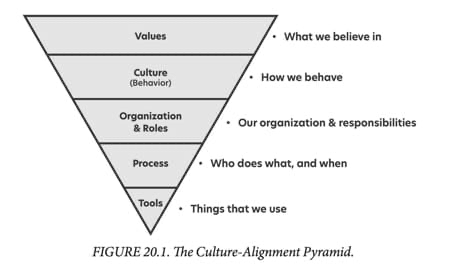
Here are some of the more-common ways that drift happens.
1. The talk/walk gap
The simplest one is probably the most common: when parts of your mission and values become mere platitudes. If you stop and think about what the value claims and then look at what people do… and what's 's not happening: that's all a platitude is. A value that your behavior refutes.
The classic pair, from years of my workshops:
• The Talk says, "Meetings should be valuable for everyone." (Or one of the twenty variations of that.)
• The Walk says your meetings suck.
Everyone in the building knows both things at once, and the distance between them teaches your people something no offsite can unteach — that the values are a sham, or that they only apply to some, but not all.
Look at how agencies do meetings (typically):
• Unavoidable calendar invite — doesn't matter how much other work you have, you can't say no… even though 50%+ of the time will be a waste, maybe all of it.
• Organizer in charge and drives, agenda optional. Maybe you contribute, Even less likely you gain any value.
• You are locked in a low-productivity zone until the meeting ends, and your penalty for attending is that you need to make up the lost time… somehow.
Read upward on the pyramid: that single most common behavior, the meeting, encodes a value system where managers matter more than you, your time is theirs to spend.
Question one: pick your proudest value. What are the behaviors in your agency that quietly refute it? Ask around.
2. The intrinsic-rewards leak
"Everyone here is a valuable contributor."
I'd guess something like that is on your wall too. Now the walk: who actually gets asked for their opinion? Who gets the cool work?
In most agencies it's "the same few people" and some version of "whoever the manager likes."
This is a process failure wearing culture's clothes. Managers choose favorites because the process lets them choose. Nothing in your process model rotates the opportunity away from the A-Team folks.
The people who never get asked don't conclude "our process has a bias problem." They conclude the value on the wall is a lie, and they quietly withdraw and underperform, often leaving — and then their next agency shines some sunlight on them, and they bloom. Just like they could have when they worked with you.
The best motivation is intrinsic: it comes from opportunity and inclusion. It's also the cheapest compensation you have, and most firms leak it by accident.
Question two: who in your firm hasn't been asked for their thinking in a month — and is that about them, or about a process that never has to ask?
3. Balkanization
Growth builds walls. Every managerial role and organizational structure creates isolation and drag. And they all take on a life of their own, little fiefdoms that implement their own processes and, of course, cultures. The firm that felt like a family at fifteen people is running tribes at forty-five.
Yes, you do need departments, and a multi-manager workplace, but you need a lot less than you think, and how you shape them shapes culture.
The social science here is old and sturdy: in-group belonging rises inside each wall, and division rises between them. Creative develops beliefs about accounts. Accounts develops beliefs about creative. Delivery has opinions about both. Each tribe's beliefs feel like hard-won knowledge, and almost none of them would survive being said out loud in a mixed room.
Nobody decided this. Balkanization is an evil weed that springs up in the shadows when structure and process aren't deliberately designed against it.
Question three: what does someone in one of your departments believe about another department that they'd never say in a mixed room?
4. The striving meritocracy
Once the walls are up, you build ladders inside them. Titles, levels, advancement lanes...you have to, or your best people leave. And then, gradually, the ladder becomes the game.
People start optimizing for what the advancement system can see. Visibility. Ownership. Credit. Lane defense.
Their attention rotates, a few degrees at a time, from the agency's mission to their own. I call this the striving meritocracy, and the cruel part is that it can feel healthy: everyone's ambitious, everyone has goals, the reviews are full of development plans.
But listen to what the heated debates are actually about. Scope disputes that are really lane disputes. Alignment meetings that are really credit negotiations. Your most senior judgment being spent on positioning instead of on clients.
Nobody stopped believing the wall. But the structure provided personal incentives.
Question four: think about your last three heated internal debates. Were they about the client's problem — or about whose title, lane, or credit was at stake?
5. AI is dissolving shared practice
Here's a new one.
Your old tools had opinions. A project management system arrives with its own theory of how work should flow, and your organization either bends to it or fights it. Constraining, often wrongly — but legible. One way of working, visible to everyone.
By the way, almost every agency I've worked with in the last decade (it's a 3-digit number) has either been about to install a new workflow system that will "solve everything" or they only recently did install it, and they are "getting the bugs out." I can't remember any agency that found that middle ground of "wow, this is working great and everybody loves it."
But that was then.
AI is the opposite pole. It has no opinion. It lets everyone do whatever they want — which can be a genuine good, but it also means whatever you had for shared methods can dissolve into a hundred private ones: personal prompts, private workflows, judgment calls nobody witnesses.
And the research says your people probably aren't just improvising… they're concealing.
KPMG and the University of Melbourne surveyed over 48,000 workers across 47 countries: 57% admitted hiding their AI use from managers and colleagues. A Cornerstone study put non-disclosure among AI users at roughly 73%. An HEC Paris experiment with consulting-firm managers found the incentive is real: analysts who concealed their ChatGPT use got better evaluations than those who disclosed. Concealment may or may not pay off, but it is very likely happening.
And why do they hide? Weak cultures create a fragile workplace contract.
The strongest predictors of whether people disclose their AI methods aren't policies or approved tools… it's organizational trust and psychological safety. Your agency's hidden-AI rate isn't more than a tools problem… it's a readout.
Question five: your people are using AI in ways you can't see. What is it about your culture that makes hiding the smarter move?
Cultural alignment creates a stronger organization
Your mission is fine. Your people mostly still believe it. Drift is not a character flaw in your firm. It's just what change does to an unattended stack. And there's always change.
Good cultural alignment gives you a buffer within your people. It builds trust and a sense of belonging. That's what will keep things moving despite the inevitable changes and challenges.
Cultural alignment is like a compass. One that everybody can see.
Steer it consciously. Keep testing the wall with each new Monday.
Know an agency leader whose wall and Monday might be drifting apart? Send this along — the five questions travel well, and they're easier to hear from a friend than from a consultant.
The five questions are alignment questions — which is the work I do. I've spent 15 years inside 200+ agencies closing the gap between the wall and the Monday, and the fix never happens at the culture layer: it happens in the behavior, roles, and process around it. If one of the five questions stung a little, that's drift talking, and it's worth a conversation. Tell me what you're seeing — no pitch, no pressure.


