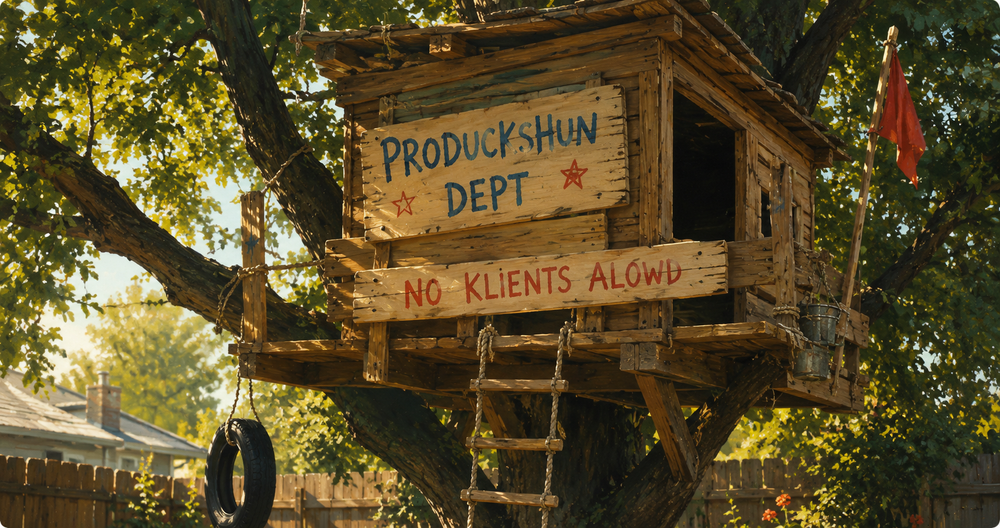
I built a career on keeping people away from teams. Okay, that's dramatic.
Clients, yes, but more so managers, account directors, well-meaning executives who wanted to “pop in” on a working session or interrupt things getting done with "a quick question", the ultimate agency oxymoron.
For fifteen years I taught agencies how to create protected space: structured handoffs, clear swim lanes, rituals designed to give creative and technical people the room to think without someone tapping them on the shoulder every twenty minutes. It worked. Dramatically, in some cases. Teams that had been drowning in reactive chaos started finishing projects on time. Quality went up. Rework went down. I had the data.
You didn't need an econ degree to understand it: a developer pulled off a build lost hours of flow state, not minutes. A designer interrupted mid-concept didn’t just lose the interruption; they lost the thread they might not find again until tomorrow. Every unplanned interaction had a multiplier on it, and the multiplier was brutal. So we built boundaries. You let the account person absorb the client, translate the client, ration the client. You built the firewall, and the firewall worked.
I don’t think I was wrong. But I do think that was then, and this, this AI-infused world, is now. The economics are changing underneath the thing I was right about.
The firewall was a package deal
Yeah, and it was a mixed bag for sure.
The firewall suppressed the bad stuff (the interrupts, the churn, the scope creep, the hallway requests that derailed a sprint) but also the good stuff (the meaning, the connection, the understanding of who you’re building for and why it matters) in a single move. The assembly work was expensive enough that protecting it justified almost any cost, including the cost of a team that had no idea what their client actually cared about.
My AgencyAgile methods, context and roadmapping, when done well, solved part of that (and still do!), at least in the early-stage moments when those rituals were performed.
Lacking that, the firewall that had helped productivity reared its ugly face come delivery time: team would produce three concepts, all technically excellent, all slightly off, because the brief said one thing and the client’s real situation was more like what the account person had heard in a hallway but hadn’t thought to pass along, or couldn’t translate into brief-language, or didn’t realize mattered. The team wasn’t bad. The team was starved, fed a thin gruel of the client’s situation and asked to render judgment on it.
All this while the research on motivation has been saying something clearly and loudly for decades: people do measurably better work when they’re connected to the person they’re building for. All three of the basic psychological drivers, the sense that your work matters to someone, the feeling that you’re effective at something real, the autonomy that comes from understanding enough to make your own calls, they all get fed by proximity and starved by distance.
We protected our teams from some genuine negatives. We also protected them from the single most powerful source of intrinsic motivation available: knowing who they’re building for, and watching it land.
Welcome to the era of the AI-assemblers
Those economics held. Until they didn’t.
When assembly work was heavy, the cost of an interrupt outweighed almost everything else. Now assembly is light, fast, and recoverable. A designer who gets pulled off a concept can regenerate the work in a fraction of the old time. The production-protection rationale thinned out. And the thing we’d been walling the team off from — the client’s actual situation, in all its mess — turned out to be the only input that makes their judgment worth more than what a machine can generate.
Judgment comes in many forms, and shows up in knowing what to ask AI for, and also how to assess the goodness of its outputs.
The agency non-firewall moment
What if there was no firewall? Every agency already knows what this looks like when it works.
It's called a pitch team. Everyone present and engaged. The client’s problem at the center, not the agency’s process. A team configured for this situation, this client, this moment. Judgment exercised live, often (and best) in front of the client, with something at stake. Knowledge building in real time between people who would normally never share a room, just a project charge number. The lucky juniors in attendance learned more in those two days than they did in the two months that followed.
Pitch-mode is the agency model at full power, and every principal knows it. But it never survives the win. The moment revenue starts flowing, the machine switches on: the seniors pull back, the account person takes over the relationship, and the team goes behind the wall to work from a brief. The quality doesn’t drop because the people got worse. It drops because the proximity ended.
I used to think that was inevitable — pitch-mode was too expensive to sustain, because the economics of delivery required the protection. What if that’s the part that changed? What if the assembly cost that forced the firewall up is now low enough that you can keep it down — not recklessly, not without structure, but deliberately, (yes, with a different structure) in a way that extends the pitch room’s engagement into delivery, into the ongoing relationship, into the way the team holds the client week after week?
That’s the work I’ve been doing with agencies lately, and I’ve started writing about it as the Y-shaped organization: a firm that stays open at the top to receive the client’s real situation, not just during the pitch but as the operating structure. There’s more to say about what that looks like in practice — the instruments, the rituals, the economics of it. For now I want to leave you with three questions worth sitting with:
What client interactions has your team been avoiding because they felt too costly or disruptive — and what would those interactions actually cost now?
How much better might your people work if they truly knew the client — not the brief, but the client? How might the client's perception of your agency change if they truly knew the team better?
And the one that took me fifteen years to ask myself: how much of your current structure is still protecting a production process that no longer needs the protection?
This is the first in my "Pricing Judgment" series on what agencies sell in the age of AI, and how to get paid for it. If you want pieces like this in your inbox when they publish, subscribe at JackSkeels.com — no spam, just the occasional article worth your time.
Going Deeper: Unbundling the Firewall
The package-deal problem deserves a closer look, because it’s the reason well-run agencies resist the change even when they intellectually agree with it.
When I installed the AgencyAgile protected-space rituals in agencies, I was solving a real problem: teams were reactive, overloaded, and producing mediocre work because they couldn’t hold a thought long enough to finish it. The fix worked because it addressed the bottleneck of the era, which was production capacity. Every hour of uninterrupted focus was worth multiples of that hour in output quality, and the math was so clear that nobody questioned what else the boundary might be doing.
Here’s what else it was doing. It was severing the team’s relationship with the purpose of their work. Consider a developer who knows they’re building a configuration tool for a sales team that’s currently losing deals because the old tool takes forty minutes per quote. That's a developer that makes different decisions than one who knows they’re building “a configuration tool” per the brief. A powerful string of micro-judgments that accumulate into the difference between work that creates results and work that’s technically correct.
The research on this (Adam Grant’s work at Wharton is the cleanest version) is almost comically clear: even five minutes of contact with the person who benefits from your work can double your output. The mechanism isn’t inspiration or warm feelings. It’s information. When you know who it’s for, you know what matters, and when you know what matters, your judgment sharpens on its own.
Agencies have always had proof of this, hiding in plain sight: the pitch. Every pitch is a temporary abolition of the firewall. The team is in the client’s situation, together, building understanding in real time. The work that comes out of pitch-mode is almost always the best work the agency produces. Then the wall goes up and the quality regresses to whatever the brief can carry, which is never enough.
So unbundling the firewall means separating the protection you actually need (structured time, clear scope boundaries, managed communication channels) from the insulation you’re paying for without realizing it (team disconnected from client reality, judgment starved of context, motivation running on fumes). The first set is operational hygiene. The second set is the cost of the old economics, and the old economics just expired.
A practical starting point: pick one client and one team. Put a maker, someone who builds the work, into one client interaction per week. Not as a notetaker. As someone with questions to ask and a perspective to offer. (Make sure they ask questions – like we do in the context method) The cost is roughly an hour per week. The interrupt cost, given what assembly costs now, is a fraction of what it was.
What you’ll see in about three weeks: the work gets more specific. The maker stops solving the brief and starts solving the situation. In about six weeks, the client starts sharing things they weren’t sharing before — not because the questions got harder, but because someone who makes their work is sitting across from them, visibly engaged with their problem, and that changes what feels safe to say.
That’s what I mean by extending the pitch room into delivery. The structure of it — who’s in the room, how often, in what format, with what instruments — is what the Y-shaped organization series is about. But the starting move is small, and the economics are already on your side.