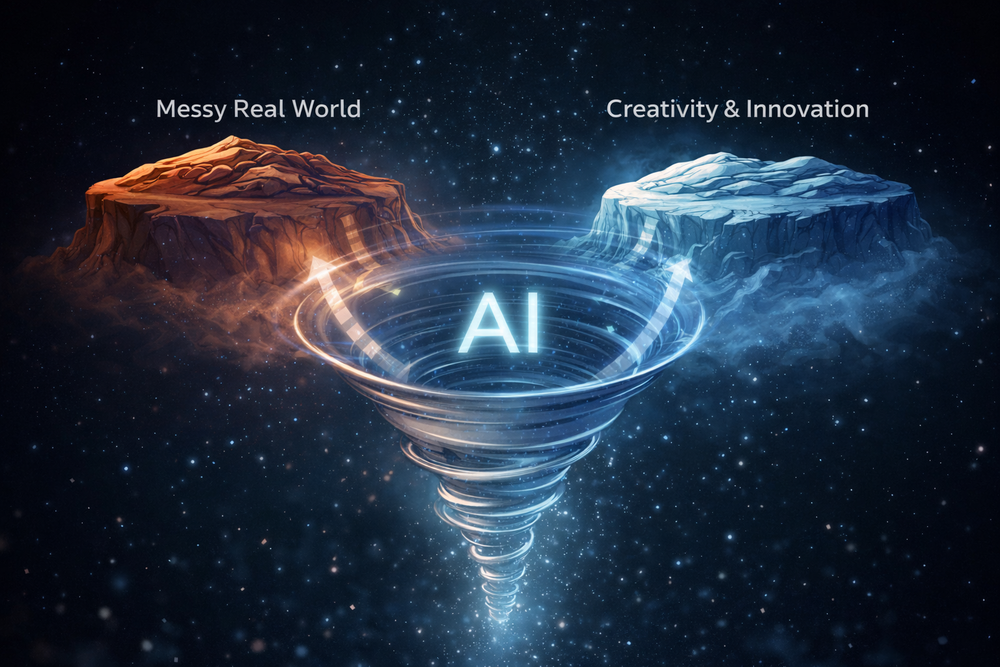
Most conversations about AI and innovation assume a simple replacement story. As automation improves, human work recedes. The messy becomes structured. Judgment gives way to systems.
That framing misses what is actually happening.
A better way to understand modern work is as a spectrum pulled toward a powerful center. On one end sits the messy real world. On the other sits purpose-built creativity and innovation. In between is an automation vortex that steadily absorbs anything that becomes sufficiently clear, repeatable, or economically tractable.
This dynamic is not new. It has been operating for centuries. AI did not invent it. AI dramatically strengthened it.
Safe Zone #1: The Messy Real World
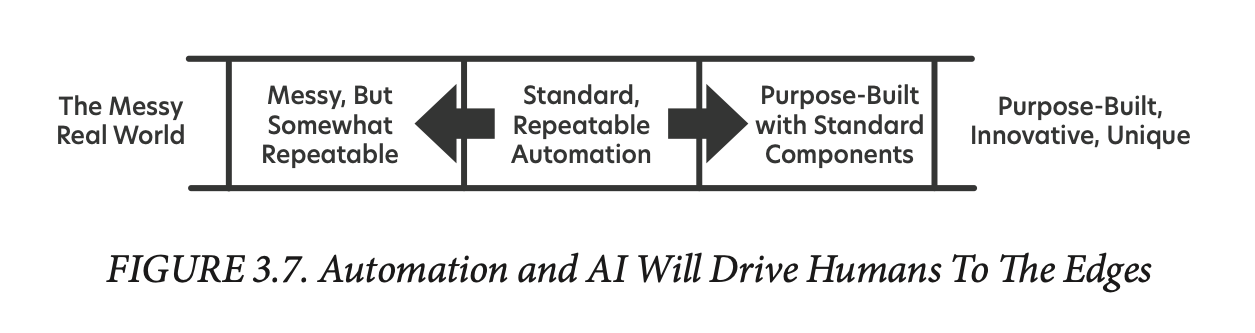
On the left end of the spectrum is the messy real world. This is where problems are embedded in human context, physical constraint, culture, trust, and risk. Consider something as simple on paper as collecting blood samples from indigenous tribes in sub-Saharan Africa.
From a distance, the task looks procedural. Identify subjects. Obtain samples. Label, transport, analyze. In reality, almost none of the work is procedural. It involves negotiating consent across languages and belief systems, understanding local power structures, building trust over time, managing fear, and responding to conditions that change day by day. Success depends on judgment, presence, and lived human interaction.
AI can assist at the margins here. It can help analyze results, optimize logistics, or surface patterns after the fact. What it cannot do is replace the human work that makes the task possible in the first place. The reality itself is irreducibly messy.
Safe Zone #2: Innovative, Creative, and Purpose-Built work
On the far right end of the spectrum is a different kind of human work. Purpose-built creativity and innovation. This is not messy in the same way, but it is just as resistant to automation.
One of the core limitations of today’s AI systems is that they are rhetorical. Large language models do not originate new ideas in the way humans do. They recombine what has already been thought, written, and said. They are extraordinarily good at navigating the space of existing language. They are fundamentally incapable of stepping outside it.
That limitation matters most at the innovative edge.
True innovation often begins precisely where language fails. Where concepts are half-formed. Where meaning is felt before it is articulated. Where the understanding required is deeper and richer than anything that can be inferred from word frequency alone. In these moments, AI does not merely underperform. It collapses into confident nonsense, because it has nothing solid to anchor to.
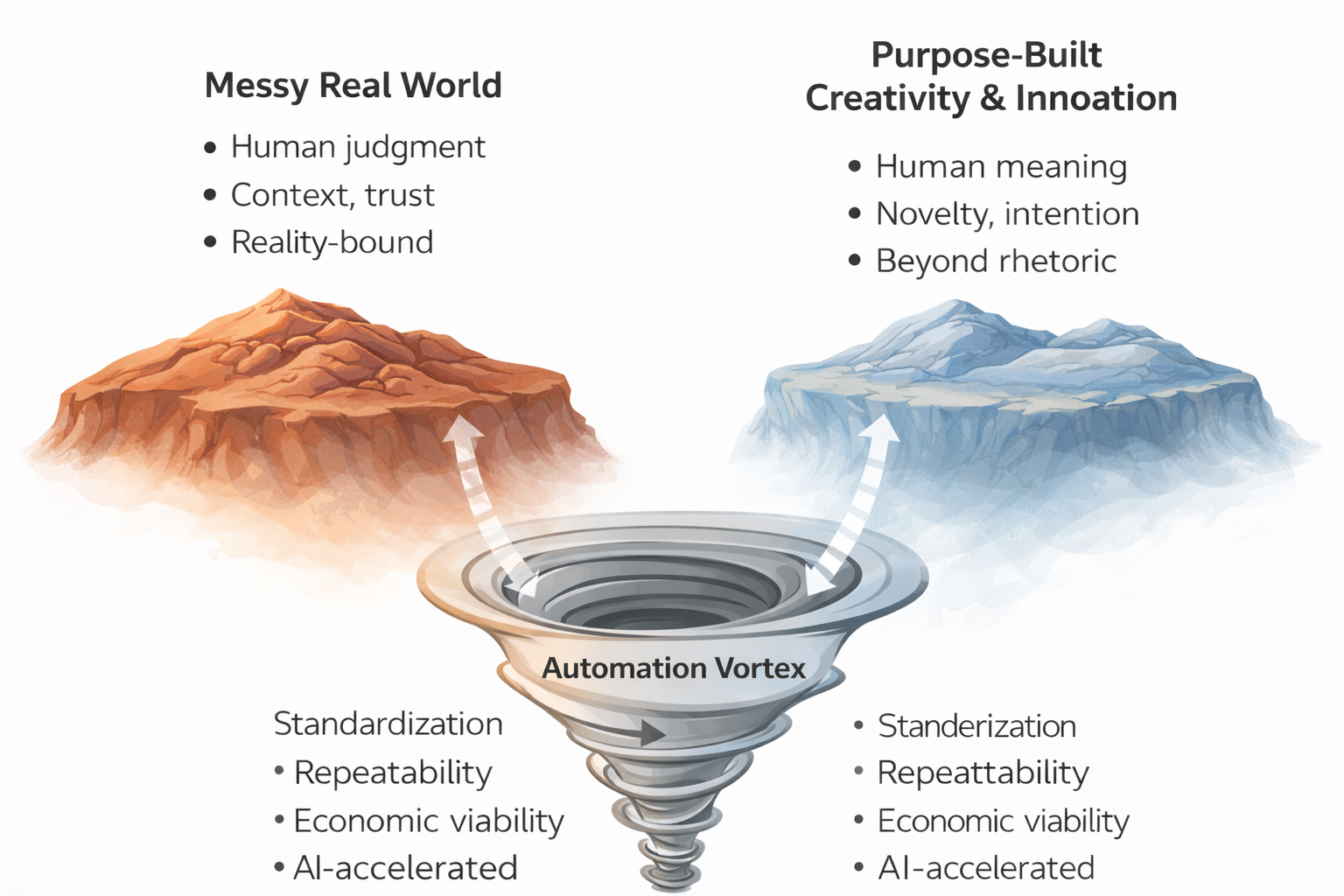
The Vortex
As messy real-world problems become better understood, pieces of them slide inward. As innovative ideas mature, stabilize, and become expressible, they slide inward too. Once work is legible enough, economics decide its fate. If it is cheaper or faster to automate, it will be automated.
AI massively expanded this middle.
By reducing the cost of synthesis, pattern recognition, and generalization, it pulled far more work into the zone where automation makes sense. That is a genuine advance.
The mistake organizations make is assuming that the growth of the vortex eliminates the need for the ends.
When AI is allowed to pull work inward too early, before the messy realities are understood, automation becomes brittle. When AI is mistaken for a source of genuine novelty or meaning, innovation becomes shallow. In both cases, rhetorical coherence is confused with real understanding.
Enjoying this article?
Get new articles delivered to your inbox — no spam, just ideas worth reading.
The Human High Ground
The human high ground never disappeared. It exists on both ends of the spectrum, for different reasons.
On the messy side, humans are essential because reality resists abstraction. On the innovative side, humans are essential because meaning, intention, and true novelty cannot be generated statistically.
The organizations that benefit most from AI will not be the ones that surrender judgment to the vortex. They will be the ones that know when to let work slide inward, and when to deliberately hold it at the messy or innovative edges long enough for human understanding to do what machines cannot.
This is part of a larger body of work I've been calling the AI Reformation — exploring what it means that today's AI is rhetorical, not intelligent, and why that distinction matters enormously for how organizations lead, decide, and design work.
If you're a leader navigating this shift and want to think it through with someone who's been deep in it — I'm at bettercompany.co.
— Jack Skeels