(and what it accidentally teaches us about how business actually works)
Every so often, someone becomes a teacher without intending to. In this case, it’s Sam Altman.
Not because he’s right, but because his claims seem to create just enough friction with reality that they force clearer thinking. First came the prophecy that AI would obliterate agencies. That won't be happening anytime soon. Now comes the claim that we’ll soon see a billion-dollar company run by a single person.
Taken literally, it’s almost certainly wrong. Taken seriously as a provocation, it turns out to be useful: It invites us to look more carefully at the nature of industry, the fabric of commerce, and what firms actually are.
One of my favorite researchers, Ronald Coase, spent his career asking a deceptively simple questions including: why do firms exist at all? His answer was not technology. It was coordination, transaction costs, and judgment under uncertainty.
This lens is one that you should be aware of in this Age of AI Hype Cycles.
Why Do We Have Companies? And Why So Many?
And overly simplified answer would look something like this: companies are an economically efficient collection of action and judgment activities. Coase asked the question, but then why isn't there just one really, really big one? And the answer to that is that the judgment activities are actually quite costly, and is an organization grows larger, there is a super-linear increase in judgment cost.
"But shouldn't AI help with that?" Not really, and it's kind of the opposite.
AI, as we know it today, is extraordinarily effective at attacking the action layer. It automates execution. It compresses production. It reduces the cost of doing things that already have a clear structure.
What it does not eliminate is judgment. In fact, it is pretty bad at it, and worse, yet, when AI accelerates the action layer of an organization, it often increases the need for judgement.
And judgment here should be understood loosely, not as abstract decision-making, but as a family of human coordination-style interactions that exist because the world is social, contested, and messy. This includes things like interpretation, negotiation, boundary-setting, tradeoff selection, exception handling, risk attribution, legitimacy management, trust repair, and coordination under ambiguity.
These are not isolated “decisions.” They are interactive acts. Often conversational. Often relational. Often adversarial. They stabilize action when incentives collide and outcomes are uncertain.
It is the judgment layer that both defines the boundary of the organization and gives it coherence.
AI can assist at the margins. It can propose language, surface options, simulate scenarios. But it cannot own these interactions, because ownership implies accountability, standing, and consequence.
Negotiation is a good example. Negotiation is not about finding the optimal answer. It is about arriving at a mutually survivable one. That requires credibility, social positioning, and the ability to absorb blame or cost. Those properties do not live in today's AI models.
This brings us back to the one-person billion-dollar company.
For that idea to work, you would need a product or service that is entirely digital, has monopoly-like demand, and whose supply chain is fully automated. No people, right? Hang on a sec, there's more.
It would need to require no ongoing interpretation, generate no serious legal or regulatory exposure, and produce no trust or reputational risk. In short, it would need to operate in a world with almost no social surface area.
At that point, you are no longer describing a company in any meaningful sense. You are describing a licensing artifact or a rent-collection mechanism.
Even that version struggles. The technologies such a business would rely on are effectively public infrastructure. Cloud compute, foundation models, APIs, payment rails. Any sufficiently capitalized competitor can replicate the industrial configuration, which is exactly how commoditization begins and margins collapse.
So, getting to a billion means no competitors, andc that durable advantage will not come from the tech. It comes from monopoly control, enforcement, regulation, exclusive distribution, and trust.
All of which require people.
Enjoying this article?
Get new articles delivered to your inbox — no spam, just ideas worth reading.
Let's Exclude the One-person Holding Company
There is also a sleight of hand embedded in many versions of this argument. It is not honest to describe a “one-person company” that owns or orchestrates a network of vendors, contractors, law firms, compliance specialists, and enforcement mechanisms as a one-person company. That is simply outsourcing the organization and pretending it disappeared.
It didn’t. It just moved off the org chart.
So the real lesson here is not that organizations are going away. It’s that we are being reminded what they actually consist of.
Organizations are not headcount.
They are structured judgment in the presence of uncertainty.
The least complex part of most organizations is the action layer. It may be expensive it may be time-consuming, and hard to find resources for, at least until the age of AI.
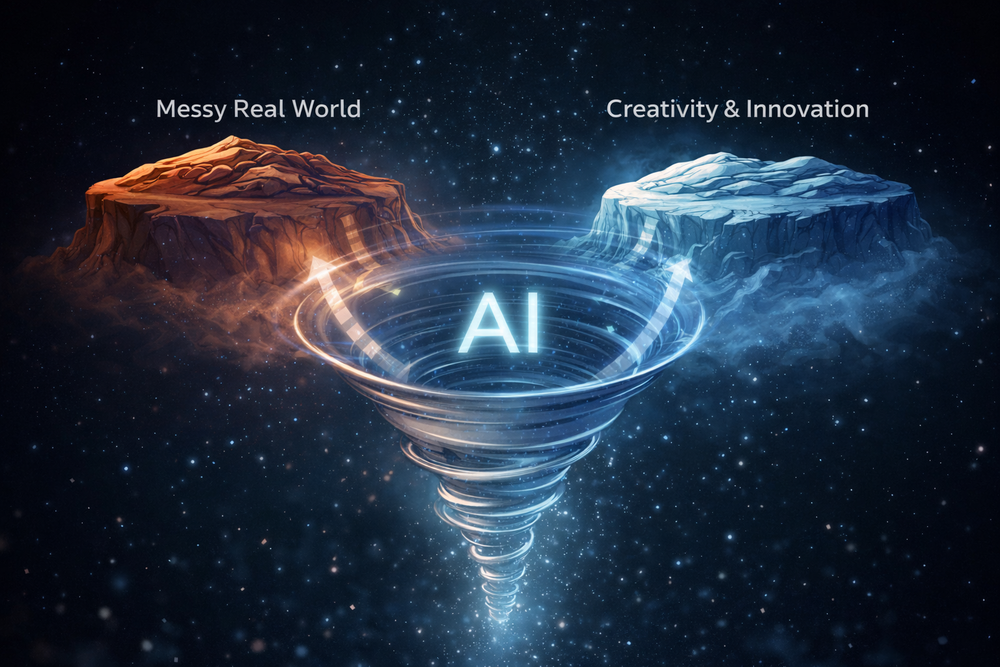
Today's AI will continue to shrink the action layer. That part is real. But the messy real world has not been repealed. And the mess is exactly where humans are still required.
If anything, that is what Sam Altman's myth accidentally teaches us—once we stop taking it literally and start using it to think.