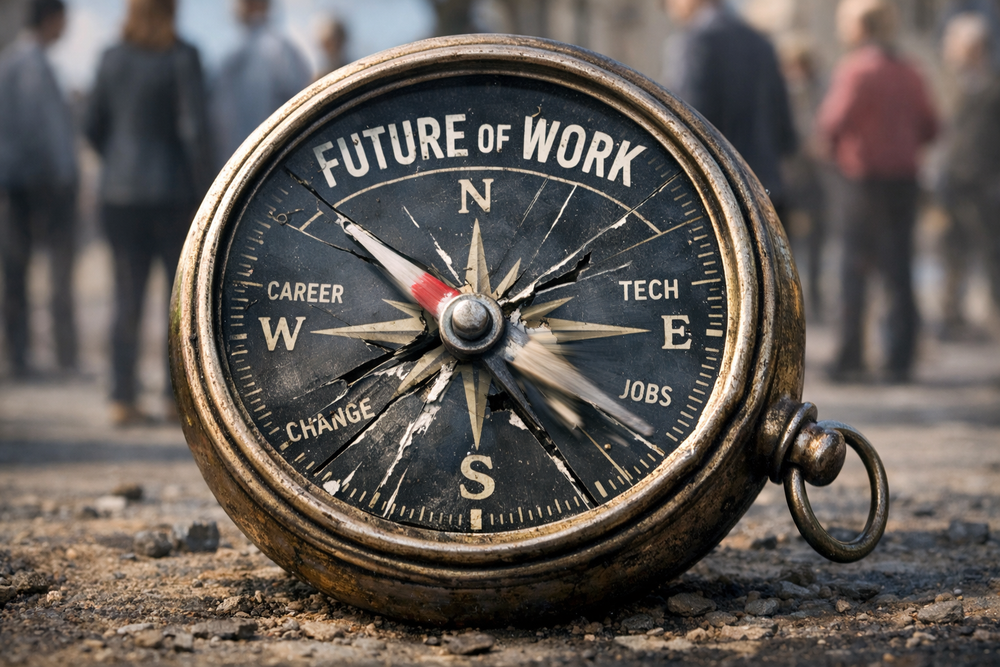
If you follow the headlines, you would think the U.S. job market is unraveling. Mass layoffs. AI replacing humans. A future where hiring people is already a mistake. A recent Wall Street Journal article (This Is Why It’s So Hard to Find a Job Right Now), Feeds this narrative by ending with a CEO saying, “I think it’s reasonable to think that that is driven by AI”.
But when you look at the actual data, the picture is almost the inverse:
- Layoffs are near historic lows.
- Unemployment remains relatively stable.
- Companies are not shedding workers at scale.
And yet hiring looks weak, workers are not quitting, and confidence in finding a new job has fallen to record lows.
That contradiction is the real story
To understand what is really happening, you have to understand a fact that is routinely ignored: most hiring in a healthy labor market is replacement hiring.
Historically, roughly two-thirds of all hires are not new jobs at all. They are replacements. People quit, retire, or move on, and firms backfill those roles. Net job creation is the smaller share. Mobility is what keeps hiring numbers high.
So, when people stop quitting, hiring falls automatically.
And that is exactly what we are seeing now. Workers are staying put. Not because they love their jobs, but because they no longer trust the market. As quits fall, replacement hiring collapses. Total hiring drops even though companies are largely holding onto their workforce.
It is a labor market frozen by fear
Now let’s talk about where the blame lies.
The dominant public explanation for this freeze is artificial intelligence. Not some careful analysis of AI’s actual effects, but rather, the relentless hype pushed by a small group of highly visible AI evangelists, like Sam Altman, Elon Musk, and in his own way, even Nate B. Jones, whom I otherwise think is a net plus, but he lends credibility to the fringe.
These are not neutral observers. They are founders, investors, executives, and professional futurists with strong incentives to frame AI as inevitable, imminent, and overwhelmingly disruptive. Their language is absolute by design.
Entire professions will disappear.
One person billion-dollar companies are coming.
Hiring humans is already a mistake.
These claims are not supported by labor market data. They are not supported by productivity data. They are not supported by observed organizational behavior and AI implementations at scale.
But they are repeated constantly.
Repetition shapes belief
So, workers absorb this rhetoric and conclude that mobility is unsafe. Managers absorb it and conclude that roles are provisional. Graduates absorb it and hesitate to commit. Firms pause hiring not because AI has replaced the work, but because AI hype has destabilized confidence in what work will look like.
Hiring falls not because jobs are gone, but because belief is gone.
This is why the most revealing labor market signal today is not layoffs or unemployment. It is perception. Surveys show a sharp rise in the share of people who believe jobs are hard to get, even while layoffs remain low, and likewise an even more precipitous decline in those who believe jobs are plentiful.
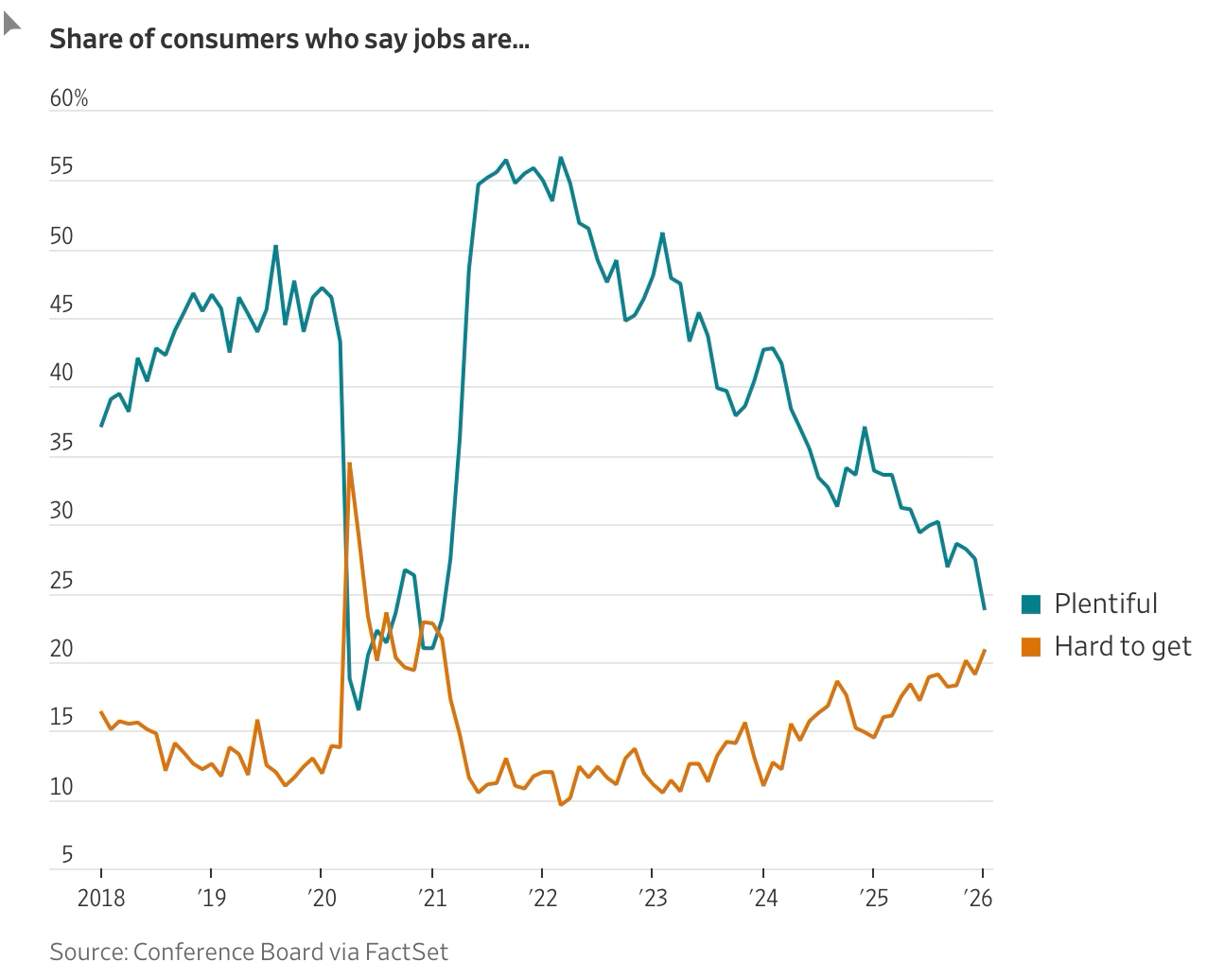
Fear is outpacing reality. And the people fueling that fear are not anonymous market forces. They are very visible figures who speak about the future with unwarranted certainty, then walk away from the downstream consequences.
Blaming “AI” conveniently obscures that responsibility. It turns human rhetoric into technological destiny. It allows those driving the narrative to claim neutrality while benefiting from attention, capital, and influence.
The cost of this mismatch is not measured in layoffs. It is measured in stalled careers, delayed transitions, and opportunities that never get taken because the future has been rhetorically declared unsafe.
Enjoying this article?
Get new articles delivered to your inbox — no spam, just ideas worth reading.
Yes, AI will change work — that is not controversial
What is dangerous is overstating its certainty and immediacy in ways that paralyze the present. That is not foresight. It is irresponsibility.
The labor market does not need fewer workers.
It needs fewer prophets.
This is part of a larger body of work I've been calling the AI Reformation — exploring what it means that today's AI is rhetorical, not intelligent, and why that distinction matters enormously for how organizations lead, decide, and design work.
If you're a leader navigating this shift and want to think it through with someone who's been deep in it — I'm at bettercompany.co.
— Jack Skeels